By Prose Coach · July 26, 2026
How to Spot AI Writing and Make Your Draft Read Human
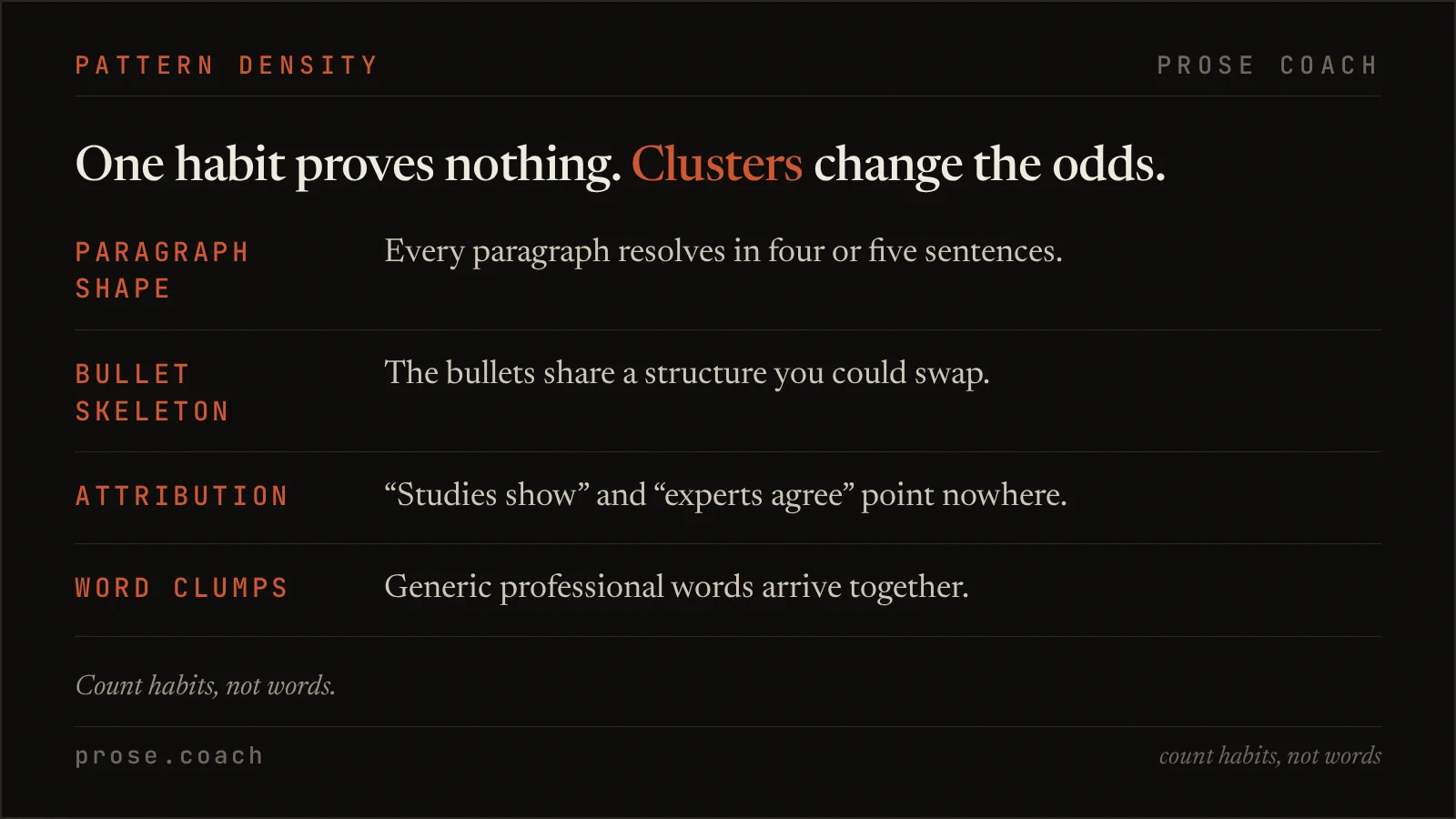
No single word proves a machine wrote something. Not "delve," not a bolded label, not an em dash. What gives a draft away is how many of those habits show up together inside the same 600 words.
TL;DR: You spot AI writing by counting co-occurring habits, not by finding one suspicious word. Watch for paragraphs that all run the same length, bullets built on an identical skeleton, attribution with no source behind it, and vocabulary that clusters in the safe middle. To confirm authorship, ask the writer for the source of one specific claim, then ask what changed since that source was published.
Count habits, not words
Start with density. One hedge is a writing choice. Six in a short piece is a fingerprint.
Here's what to scan for. Paragraphs that all resolve in four or five sentences, none short enough to land and none long enough to develop. Bullets that share a skeleton so exactly you could swap them without noticing. Attribution that goes nowhere: "studies show," "many experts agree." Examples that name nothing, where a real product becomes "a popular platform." And vocabulary in clumps, four or five words like holistic, paradigm, robust, and transformative sharing one page.
The em dash deserves its own note, because the internet has turned it into a witch hunt. The mark isn't the tell; writers have used it for centuries to interrupt themselves. What reads as machine-made is placement, the same connective slot sentence after sentence, doing work a comma would do better.
Paragraph shape is harder to see, because it sits above the sentence. Structural tells AI detectors flag covers the loop that gives most drafts away: topic sentence, generic explanation, broad example, restatement.
The two-question check
When authorship matters, stop reading and start asking. Two questions, about thirty seconds.
First, pick the most specific claim in the piece, a statistic or a named recommendation, and ask where it came from. Someone who did the research names the source immediately. A model hedges or invents a plausible citation.
Second, ask what changed since that source was published. This is the one that separates them. A person who follows the subject knows what's gone stale. A model has a training cutoff and no way to know it's behind.
If both answers land, you're done. If they don't, move to provenance instead of arguing about style: revision history and timestamps are harder to fake than prose and easier to check than any score.
Name the cost before you run this. Asking a colleague to defend a claim is an accusation whether you frame it that way or not, so save it for when the stakes justify the friction.
Where detectors help and where they hurt
Detectors measure two statistical properties: how predictable your word choices are, and how much that predictability varies across the piece. Flat and predictable scores as machine-made.
The failure mode follows from the method. Formal human writing is also flat and predictable. Popular Science tested five detectors and got inconsistent results across samples, with some tools missing generated text and others flagging human text. That inconsistency isn't a bug in one product; it's what happens when you infer authorship from style.
The people who pay for that inference are non-native English speakers and anyone trained to write formally, whose prose looks exactly like what the tool is built to catch. A score is a reason to look closer, nothing more. What AI detector scores actually mean covers reading the number without over-trusting it.
Two rewrites, and what moved
Diagnosis is the easy half.
An email opener:
I hope this message finds you well. I wanted to reach out regarding the comprehensive report we discussed.
Rewritten:
Following up on the Q2 report from Tuesday. Two questions about the methodology section.
A blog paragraph:
Many experts agree that content strategy is essential for growth. Studies show that businesses with a clear plan outperform those without one.
Rewritten:
A content strategy without a named audience is just a publishing calendar. The teams I've watched skip the audience question spend months shipping posts that rank and convert nobody.
Three things moved in both. A vague reference became a specific one. The hedge disappeared and left a claim someone has to stand behind. And the sentences stopped matching each other in length, the part a synonym swap never fixes.
Purpose-built drafting tools produce these same defaults, which is why spotting them in published work trains your eye for your own. A long-form fiction assistant and a marketing copy generator both reach for the statistical middle, because that's what the model underneath was trained to do. The tool changes; the habit doesn't. How to rewrite AI text to sound human works through the full repair sequence in order.
The signal no detector reads
Every tell above is surface. The deeper one is the absence of a position the writer had to defend.
Generated text agrees with whatever premise the prompt handed it, routes around the uncomfortable exception, and lands on a tidy conclusion because a tidy conclusion is the likeliest next token. Human writing drifts. A paragraph opens with a claim, complicates it partway through, and finishes somewhere the writer didn't plan, because a detail refused to fit.
So the useful question when you edit an AI-assisted draft isn't whether it sounds human. It's whether anything in it is something you believe and can defend. If not, varying your sentence lengths just produces prose that reads smoothly and says nothing.
Prose Coach works on the rules the model writes by, so the uniform cadence and the safe vocabulary never reach the page in the first place. It won't supply the position you're willing to defend, though. That part stays yours.
FAQ
What are the most reliable signs of AI writing?
Clusters, not single words. Uniform paragraph length, bullets with an identical skeleton, attribution with no named source, and vocabulary that arrives in clumps are the four worth scanning for. Five or six of them together shift the odds; any one alone proves nothing.
How do I know if text is AI generated without a detector?
Ask the author where one specific claim came from, then ask what changed since that source was published. Someone who did the work answers both quickly and specifically. With no author to ask, look for revision history or file timestamps instead.
Does using an em dash mean writing is AI generated?
No. Em dashes are standard punctuation and careful writers use them deliberately. The signal is repetition: the same connective slot filled the same way across many sentences, where a comma would read better.
Can editing an AI draft make it read like a person wrote it?
Yes, if the edits change substance and not just vocabulary. Naming specific examples, cutting hedged attribution, and letting sentence lengths vary do most of the work. Synonym replacement leaves the structure intact, and structure is what a reader notices first.