By Prose Coach · July 21, 2026
Structural Tells AI Detectors Flag Before They Read the Words
You can remove every suspicious word from an AI draft and leave the giveaway intact. The problem may be sitting above the sentence level, in the way each paragraph arrives, expands, and closes.
TL;DR: AI detectors can flag repeated paragraph shapes, even when the vocabulary looks clean. Watch for topic sentence, generic explanation, example, and restatement loops, then give each paragraph a different job.
The paragraph template is the tell
Generated prose often follows a reliable four-step loop. It states the topic, explains why the topic matters, gives a broad example, then closes with a sentence that translates what the reader just saw.
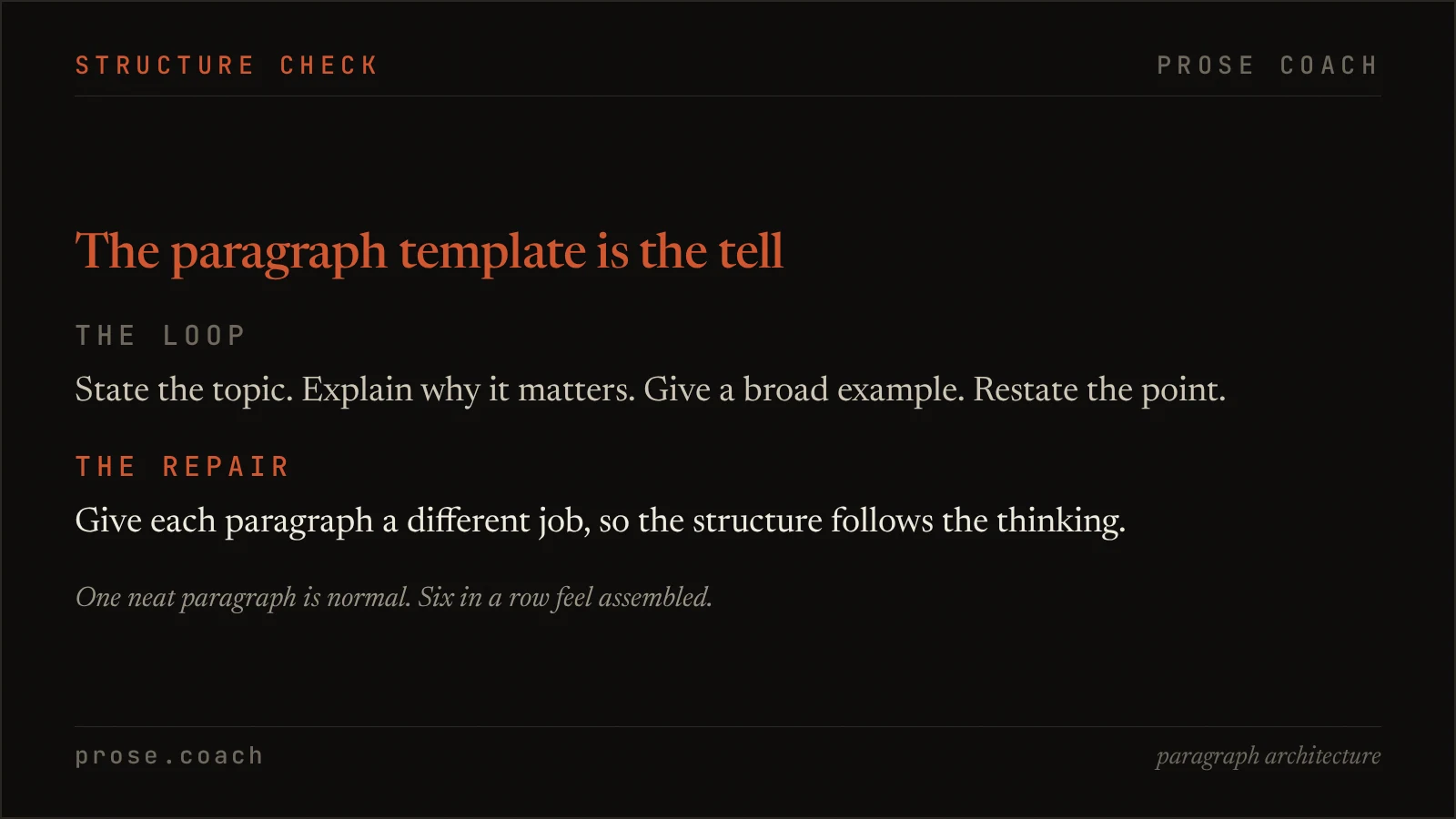
One paragraph like that is ordinary. Six in a row feel assembled. The reader starts seeing the mechanism instead of the idea.
Here’s the pattern in the wild:
Clear communication is important for effective teamwork. When team members understand their responsibilities, they can collaborate more efficiently. For example, regular check-ins help everyone stay informed. This shows why communication is essential for team success.
The paragraph has no grammatical failure. It has no risk. Every line performs the safest possible version of its job, and the final sentence repeats the opening with broader nouns.
This is the same problem that appears in AI writing patterns detectors flag, but the unit of repair is larger than a phrase. You’re editing the paragraph’s architecture.
Four structural tells to look for
1. Every section opens with a definition
AI drafts love a heading followed by a sentence that defines the heading. “Time management is the practice of organizing tasks to achieve goals.” “Feedback is information that helps people improve.” Those lines sound reasonable because they could introduce almost any article on the subject.
Definitions have a place. They shouldn’t be the default entrance to every section.
Open with the pressure instead. “Your calendar isn’t crowded because every task matters. It’s crowded because nothing has a stopping rule.” The second line gives the reader a problem to think about, not a label to memorize.
2. Every paragraph carries the same weight
Look at the visual shape of the draft. If every block is three or four sentences, each with a topic sentence and a neat landing, the argument probably has one speed.
Human writers let the material decide the size. A hard claim may need two blunt lines. A qualification may need a dense paragraph. A concrete example might stand alone.
Uniform paragraph length isn’t proof of machine authorship. It’s a pressure signal. When every section receives identical space, the writer may be following a template instead of following the thought.
The fix isn’t random compression. Split the paragraph that does two jobs. Keep the dense paragraph when the reasoning needs it. Let a short line stop without explaining why it matters.
3. Every example stays generic
AI-generated examples often describe a category rather than an event. “A business might face communication challenges during a project.” The sentence sounds like an example, but nothing happened in it.
Specificity changes the structure because it gives the paragraph a consequence to arrange:
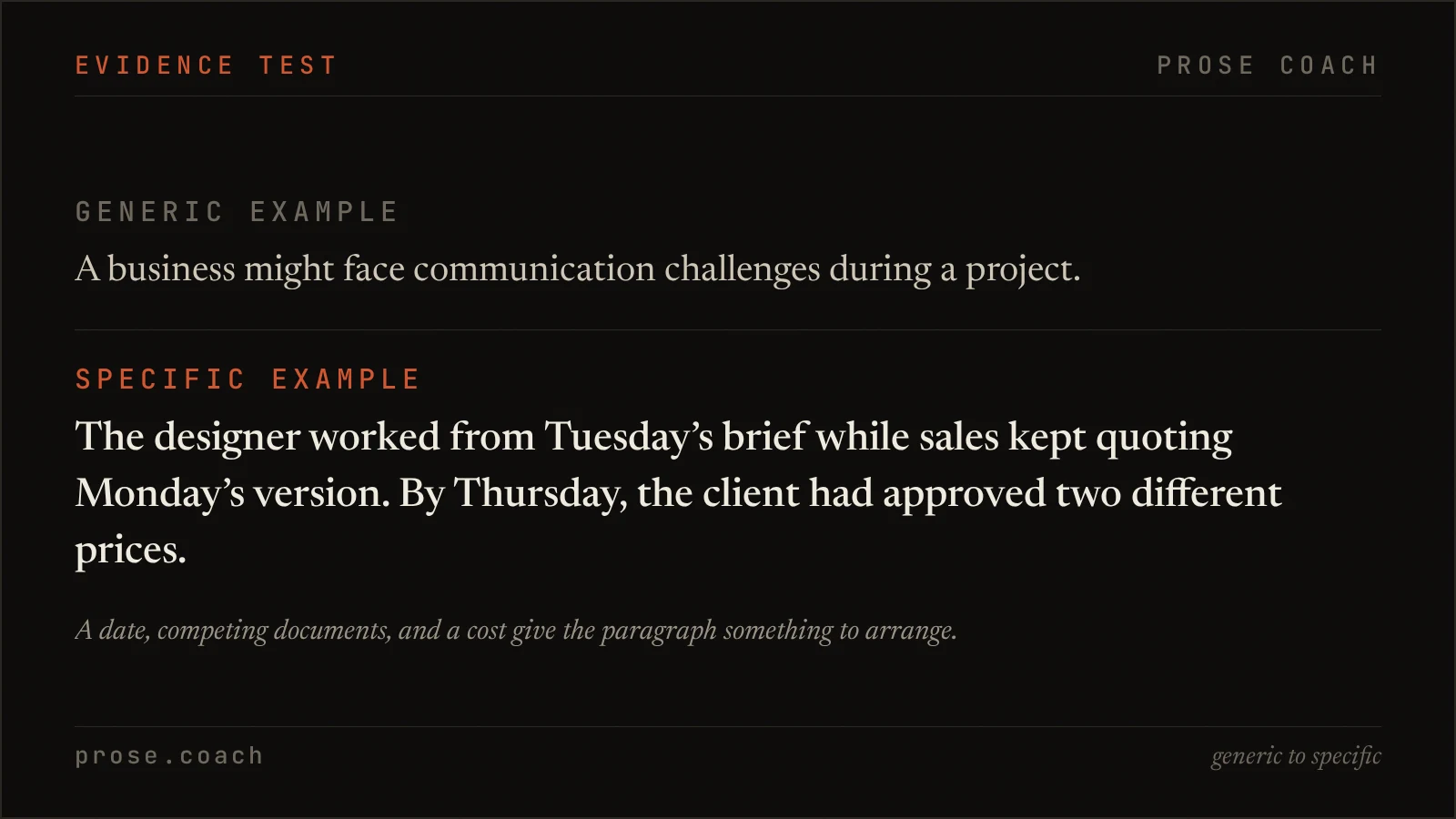
The designer worked from Tuesday’s brief while sales kept quoting Monday’s version. By Thursday, the client had approved two different prices.
That example does more work than a paragraph about “the importance of cross-functional communication.” It gives the reader a date, competing documents, and a cost.
The trade-off is exposure. Once you name what happened, you can’t hide behind “challenges.” The detail may reveal that the writer missed a deadline or made the wrong call. That friction is part of why the prose sounds written.
For more on this shift, replace categories with evidence before you start swapping synonyms.
4. Every section closes with a lesson
The polished restatement is the easiest tell to cut. A paragraph makes its point, then adds, “This demonstrates the importance of…” The sentence treats the reader as if they missed the paragraph.
Try deleting the last line. If the example already carries the argument, stop there.
The approval chain had six people in it. The launch slipped three weeks while the file moved between inboxes.
That ending leaves a consequence on the page. It doesn’t add “This demonstrates why efficient approval processes are important.” The reader can do that math.
This matters for rhythm too. As sentence rhythm and AI detection explains, a draft can vary word count and still sound mechanical if every paragraph lands in the same place.
Give paragraphs different jobs
The most useful editing question is not “Does this sound human?” It’s “What is this paragraph doing that the last one didn’t?”
Name the job in the margin: claim, case, limit, decision, scene, or turn. If three consecutive paragraphs all say “the topic matters,” the piece needs a change in function, not another adjective.
One paragraph can make the claim. The next can show the moment that forced it. A later paragraph can name where the claim stops working. That sequence creates movement because the reader receives new kinds of information.
Don’t force every paragraph to sound rough. Excessive variation has a cost: the prose can become theatrical, and the reader starts noticing the editing tricks. The aim is enough change to make the structure follow the argument.
Fix structure before polishing vocabulary
Run a structural pass before you open a synonym list. Circle repeated openings. Mark paragraphs that end by translating themselves. Put a star beside examples that could fit any company, classroom, or project.
Then make three changes. Give one section a pressure-first opening. Replace one generic example with a detail you can defend. Cut one closing explanation that the evidence has already earned.
Prose Coach checks paragraph structure alongside vocabulary, sentence rhythm, and voice drift. Its purpose is to catch the model’s default shape before you spend an hour polishing sentences that still arrive in the same formation.
The cleanest draft isn’t the one with the most variation. It’s the one where the structure changes because the thinking changes.
FAQ
What structural tells do AI detectors flag?
Common tells include repeated paragraph templates, identical section openings, generic examples, and closing sentences that restate the point. None proves AI authorship, but accumulation can make a passage feel predictable.
Can AI detectors identify paragraph structure?
Some detection systems analyze statistical patterns across a passage, not just individual words. Repeated syntax and uniform paragraph behavior can contribute to that signal, although detector scores remain imperfect and cannot establish who wrote a text.
How do I make AI writing sound less structured?
Give adjacent paragraphs different jobs, such as claim, example, limit, or decision. Vary paragraph length when the reasoning calls for it, and cut explanations that merely repeat evidence already on the page.
Should I delete every generic example from AI writing?
Delete generic examples when they stand in for evidence the reader needs. Keep a broad example when the subject truly has no specific case, but label the limit instead of pretending the abstraction proves anything.
Does changing words remove AI writing patterns?
Word changes can hide a few stock phrases while leaving the paragraph’s shape untouched. Structural editing works at the level where repeated openings, generic evidence, and restatement loops live.