By Prose Coach · July 26, 2026
The Best AI Essay Humanizer Can't Fix a Weak Essay
Most people searching for the best AI essay humanizer have already decided what the problem is. The essay reads like a machine wrote it, so they want a tool that makes it read otherwise. That diagnosis is half right, and the half it gets wrong is the expensive half.
TL;DR: An essay humanizer changes surface features: sentence length, vocabulary, paragraph shape. Those are real problems and it can genuinely fix them. What it can't do is supply an argument you didn't make, and if you're submitting work under a disclosure policy, a lower detector score isn't the thing you actually need.
What a humanizer actually changes
The category is more honest than its marketing. These tools operate on measurable properties of text, and they work on the ones they target.
Sentence length is the big one. Model output clusters around a comfortable middle length and stays there, which is what makes a page feel weightless. A humanizer breaks that up. Vocabulary is next: swapping the register-inflated word for the plain one, cutting the courtesy phrases that fill space without carrying meaning. Paragraph shape is third, and it's the one most tools handle worst, since restructuring an argument takes more than rewriting its sentences.
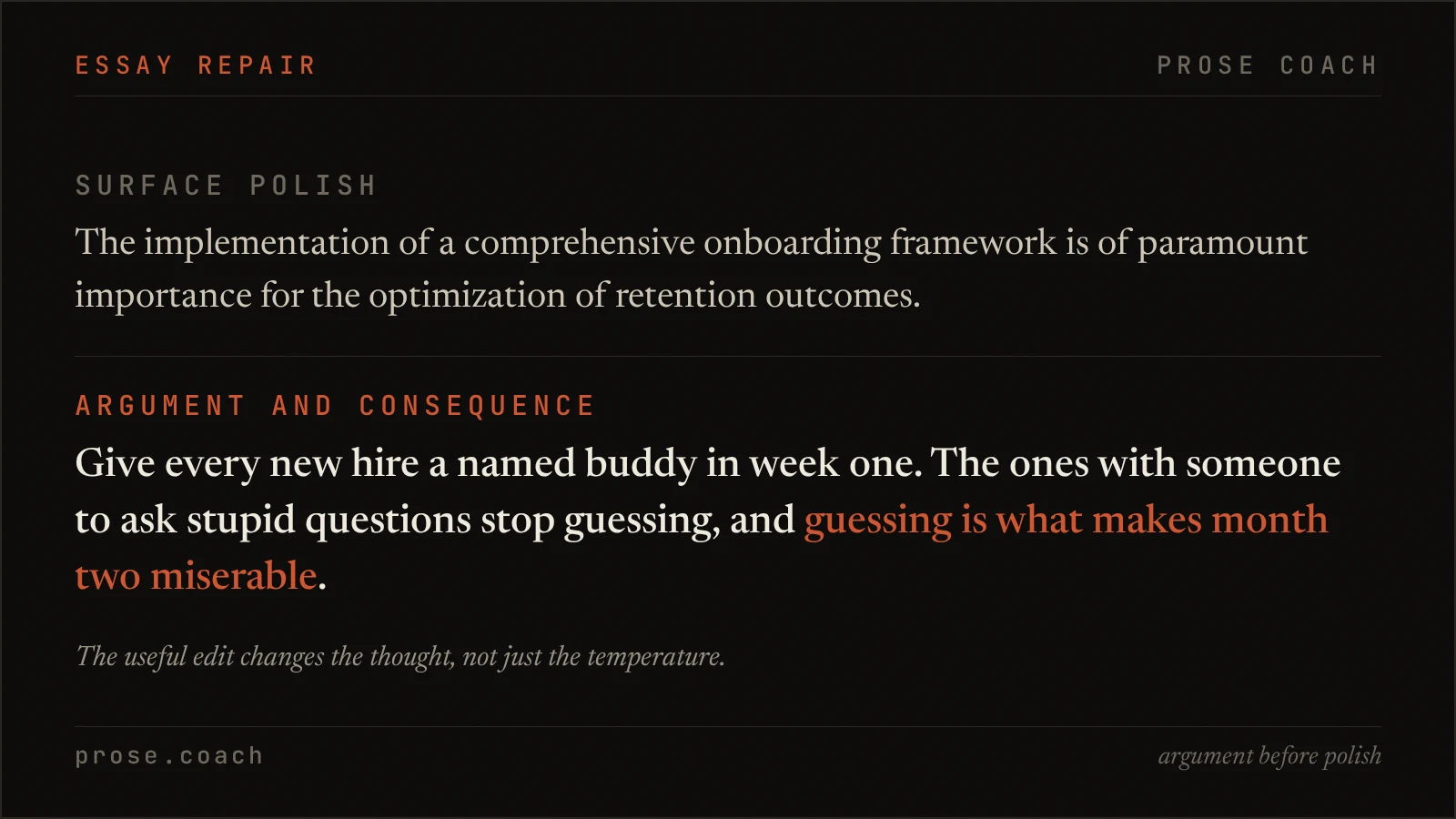
Here's the kind of repair that's genuinely worth having:
The implementation of a comprehensive onboarding framework is of paramount importance for the optimization of retention outcomes.
Rewritten:
Give every new hire a named buddy in week one. The ones with someone to ask stupid questions stop guessing, and guessing is what makes month two miserable.
The second version is shorter, names a specific action, and takes a position someone could argue with. That last part is the tell that a person wrote it.
Six things worth checking before you pay
The differences between these tools matter more than their rankings.
Look for a scanner that names what it found rather than returning a bare score. Diagnostic feedback lets you fix three sentences; a percentage leaves you rewriting blind. Check whether voice controls exist at all, because a tool that rewrites everything into the same neutral register has replaced your problem with a different one. Confirm it edits structure and not just synonyms. Ask where it runs, since a separate web app you paste into adds friction to every draft. Read the data policy and find out whether your work gets stored or trained on. And check that a free tier lets you test on something real before a card is required.
Worth separating two product categories that get shelved together. A rewriter takes finished text and changes it. A coach works on how you write before the text exists, which is a different intervention with a different payoff curve. Tools built to coach communication rather than rewrite it aim at the habit instead of the artifact. The rewriter fixes today's draft. The coach changes what your next one looks like.
Who this actually helps
There's a reader this category serves completely, and the marketing rarely names them.
Plenty of people write long-form argumentative prose where the thinking is entirely theirs and the first draft came out of a model: analysts, consultants, policy writers, anyone producing a report on a deadline. The argument is yours. The reasoning is yours. What the model handed back is a competent, flat, weightless version of it, and that's a rhythm and specificity problem, which is exactly the problem these tools were built for.
That reader gets full value from a humanizer, because nothing is being concealed. The work is honest and the prose is bad, and only one of those needs fixing. Rewriting AI text to sound human walks the repair sequence in order.
Prose Coach sits one step earlier than a rewriter: it constrains how the model drafts, so the flat cadence and safe vocabulary don't reach the page and need removing. It isn't a way to submit work you didn't do, and it can't hand you a position worth defending.
The premise worth refusing
Which brings up the search that sends most people here, and the one case where none of the above applies.
If you generated an essay and you're looking for a humanizer so you can submit it, no tool on the market solves your problem, and the ones promising to are selling you exposure. A flagged submission at most institutions routes to a person, and that person asks for the work behind the work: draft history, source notes, the version from three days ago. A polished file plus an explanation is not evidence. A confirmed attempt to defeat the scan is a different category of trouble than a flag on honest work.
The technical argument lands in the same place. Detectors retrain, so any claim of permanent undetectability is a claim about a competitor's release schedule. Substitution-based rewriting also introduces the awkward phrasing a human reader catches even when the scanner doesn't. You can pass the scan and fail the professor.
There's a separate case that deserves saying plainly: if you wrote the thing yourself and got flagged anyway, you don't need a humanizer, you need to understand why detectors flag real writing. Formal prose and non-native English both read as statistically regular. Running honest work through a rewriter to satisfy a false accusation is a bad trade, and it destroys the draft history that would have cleared you.
FAQ
What is the best AI essay humanizer?
That depends on what you need it to fix. For flat rhythm and inflated vocabulary in prose you actually wrote or reasoned through, pick the tool with a diagnostic scanner and real voice controls rather than the highest-ranked one. For submitting generated work under a disclosure policy, no tool is the right answer.
Does an AI essay humanizer actually work?
For sentence rhythm, vocabulary, and paragraph shape, yes. Those are measurable features and rewriting genuinely changes them. For making generated text permanently undetectable, no, because detectors retrain and substitution-based edits introduce phrasing a human reviewer notices.
Is using an AI essay humanizer cheating?
It depends entirely on whose thinking is in the essay and what your institution's policy requires. Polishing prose you reasoned through yourself is editing. Disguising work you didn't do is misconduct, and a lower detector score doesn't change that or satisfy a disclosure rule.
Will a humanizer stop a detector from flagging my essay?
Sometimes, temporarily. The signals that move most are specificity and sentence-length variation, not word swaps. If your own writing keeps getting flagged, the cause is usually formal, statistically regular prose rather than anything you did wrong.