By Prose Coach · July 26, 2026
Jasper Alternatives: What a Tool Swap Actually Fixes
People shopping for Jasper alternatives usually want two things at once. A smaller invoice, and copy that stops sounding like copy.
The switch delivers the first one. The second one travels with you.
TL;DR: Claude, ChatGPT, Writesonic, Copy.ai, and Rytr each beat Jasper on some dimension, and the general-purpose models hand you better raw prose to start from. None of them removes the pattern problem, because the pattern comes from how these models generate text, not from which vendor sells you access. Plan your effort around revision.

Why the shortlist exists
Jasper's published pricing now runs two tiers, Pro and Business, with a seven-day trial and no permanent free plan. The entry-level Creator tier that comparison posts still quote has come off the page, and the trackers quoting it disagree with each other about whether it was $39 or $49. Check Jasper's pricing page before you budget against a number you read in a listicle.
Price is the stated reason people leave. It's rarely the whole reason.
The other one is template gravity. Jasper is organized around marketing templates, and templates are built to produce consistency. Consistency at the sentence level is the first thing both readers and detectors notice. When every paragraph opens the same way and lands on the same beat, a reader feels the machinery before they can name it.
The shortlist
| Tool | Built for | Billing | Strongest at |
|---|---|---|---|
| Claude | General reasoning, long-form | Subscription | Prose quality, tonal range |
| ChatGPT | General purpose | Subscription | Versatility, custom instructions |
| Writesonic | SEO content | Subscription | Live search data inside the draft |
| Copy.ai | Go-to-market workflows | Subscription | Multi-step automation |
| Rytr | Short-form volume | Subscription | Cost per output |
| Prose Coach | Revising AI drafts | One-time, $39 | Removing structural patterns |
Vendor pricing moved more than once in the first half of 2026. Confirm any figure on the vendor's own page rather than a comparison post, including this one.
What switching actually fixes
Better raw material, and that isn't nothing. A Claude draft usually arrives with more variation in sentence length and a wider tonal range than template-driven output. That means less structural surgery per page.
The instruction tax also drops. General models take direction. Tell Claude to keep the opening paragraph under fifteen words a sentence and to stop putting transition words at the head of paragraphs, and it will try. A template tool applies the template.
What switching doesn't fix
Every tool on that list selects the next word by probability. That mechanism is what produces the tells, and the mechanism doesn't change when the logo does.
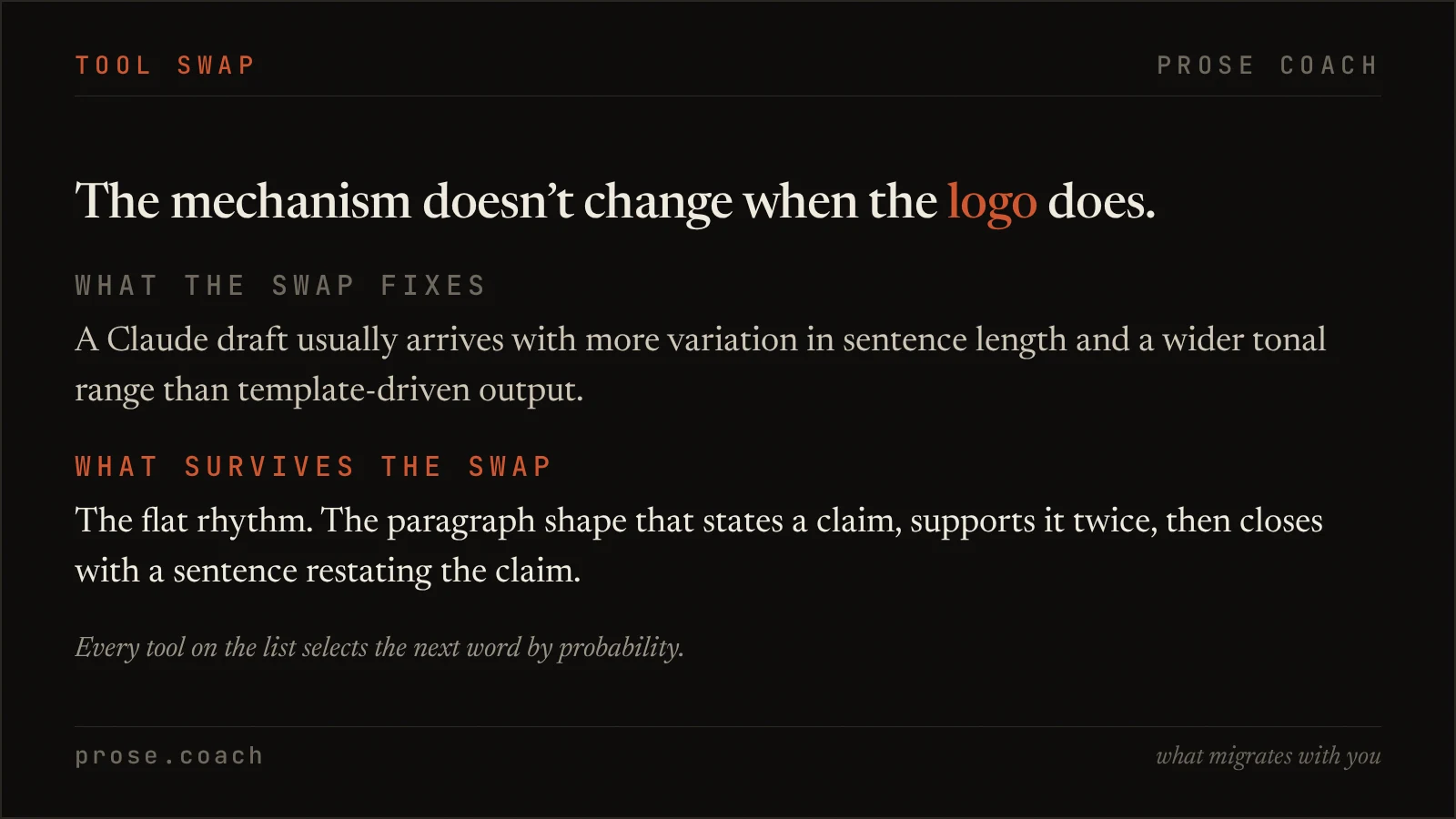
The flat rhythm survives the migration. So does the paragraph shape that states a claim, supports it twice, then closes with a sentence restating the claim. So does vocabulary that reaches for the most available word every time.
A writer who moves from Jasper to Claude and skips revision gets text that is quieter about the same problem. The structural patterns detectors flag are not vendor-specific.
Where the effort belongs
Four changes do most of the work, and none of them require a subscription.
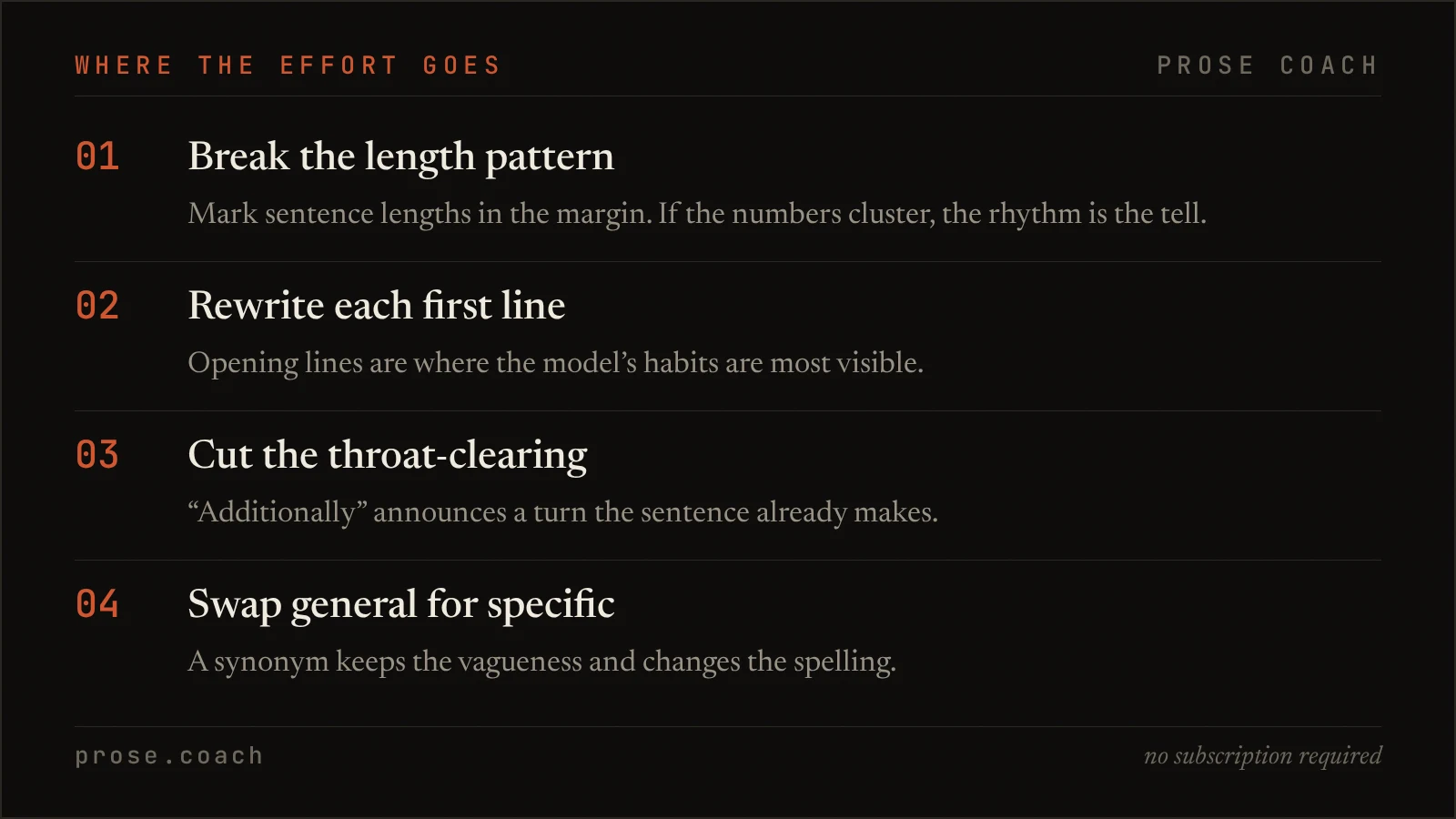
Break the length pattern. Read a page and mark sentence lengths in the margin. If the numbers cluster, the rhythm is doing the flagging, not the words. Flat sentence rhythm is the tell that survives the most editing.
Rewrite the first line of every paragraph. Opening lines are where the model's habits are most visible, because that's where it decides what shape the paragraph will take.
Cut the connective throat-clearing. "Additionally," "Furthermore," and "It's important to note that" announce a turn the sentence already makes. Transition filler is cheap to remove and expensive to leave in.
Replace the general noun with the specific one. Not a synonym. A synonym keeps the vagueness and changes the spelling. Vocabulary variety alone won't move a detection score, because rare words can decorate an empty claim.
The volume problem
Hand revision works fine over 1,200 words. It stops working at 90,000.
Writers at book length hit a different constraint: the editing pass costs more hours than the drafting pass saved, which cancels the reason they brought a model in. That's the gap AI novel writing platforms are built to close, and it's the same reason a rules-based revision layer matters more at volume than at essay length. A checklist you apply by hand doesn't scale past a few thousand words. A rule the model applies while it drafts does.
Where Prose Coach fits
Prose Coach isn't another place to generate text. It's a revision skill that installs inside ChatGPT, Claude, or Cursor and applies a structured pass to the draft you already have.
It scans for the structural and rhythmic patterns that make prose read as machine-made, then tells you which sentence is doing it and why. The PRO version is a one-time $39 purchase with a free tier at $0, which puts it outside the subscription stack you're already paying for.
One honest limit: it works inside those three tools. If your workflow lives in a standalone web app, this doesn't fit it.
What is the best Jasper alternative for human-sounding output?
Claude produces the most natural long-form prose of the general-purpose models and needs the least structural editing afterward. It still needs some.
Does switching from Jasper make AI text undetectable?
No. Tool choice changes the quality of your starting draft. The patterns detectors measure come from how language models generate text, so they persist across vendors until someone revises them out.
Is there a free Jasper alternative?
Claude and ChatGPT both have free tiers with usable output and no card required. Prose Coach has a free tier for the revision side.
How is Prose Coach different from the other tools on this list?
The others generate. Prose Coach revises, and it runs inside the tool you already use rather than adding another platform to manage.
Can any tool guarantee a clean AI detection score?
No, and any product claiming otherwise is selling a result it can't control. Detectors update their models, and no text analysis can prove authorship.