By Prose Coach · July 22, 2026
Are AI Detection Tools Accurate? What Their Scores Actually Mean
An AI detector gives you a number, then leaves you to decide whether the number means anything. That is backwards. Before you edit a sentence or accuse a writer, you need to know what the score can actually tell you.
TL;DR: AI detection tools are pattern classifiers, not authorship records. They can identify writing with predictable rhythm, word choice, and structure, but a score can't prove who wrote it. Treat the result as an editing signal or a reason to review process evidence, never as a verdict.
Accuracy isn't one question
When someone asks whether an AI detector is accurate, they usually mean one of three things.
Can it separate a large sample of model output from a large sample of human writing? Can it avoid flagging clean human prose? Can it tell who wrote one particular document?
Those are different tests. A tool may perform well in a controlled comparison and still fail on a short memo, a polished student essay, or a passage written by someone who learned English from formal textbooks. The last question, authorship, is the one these tools can't answer from text alone.
That distinction matters because the score looks more precise than the evidence behind it. A percentage is still a classification estimate.
What detectors actually notice
Most AI detectors look for statistical regularity across a passage. The exact methods differ, but the recurring signals are familiar: sentences cluster around similar lengths, paragraphs resolve in repeatable shapes, and word choices favor the safe middle.
That is why deleting a list of suspicious words rarely fixes the draft. The words may change while the architecture stays intact. Sentence rhythm is the AI tell your word list misses explains the problem at the level readers feel first: the cadence between sentences.
Read this paragraph:
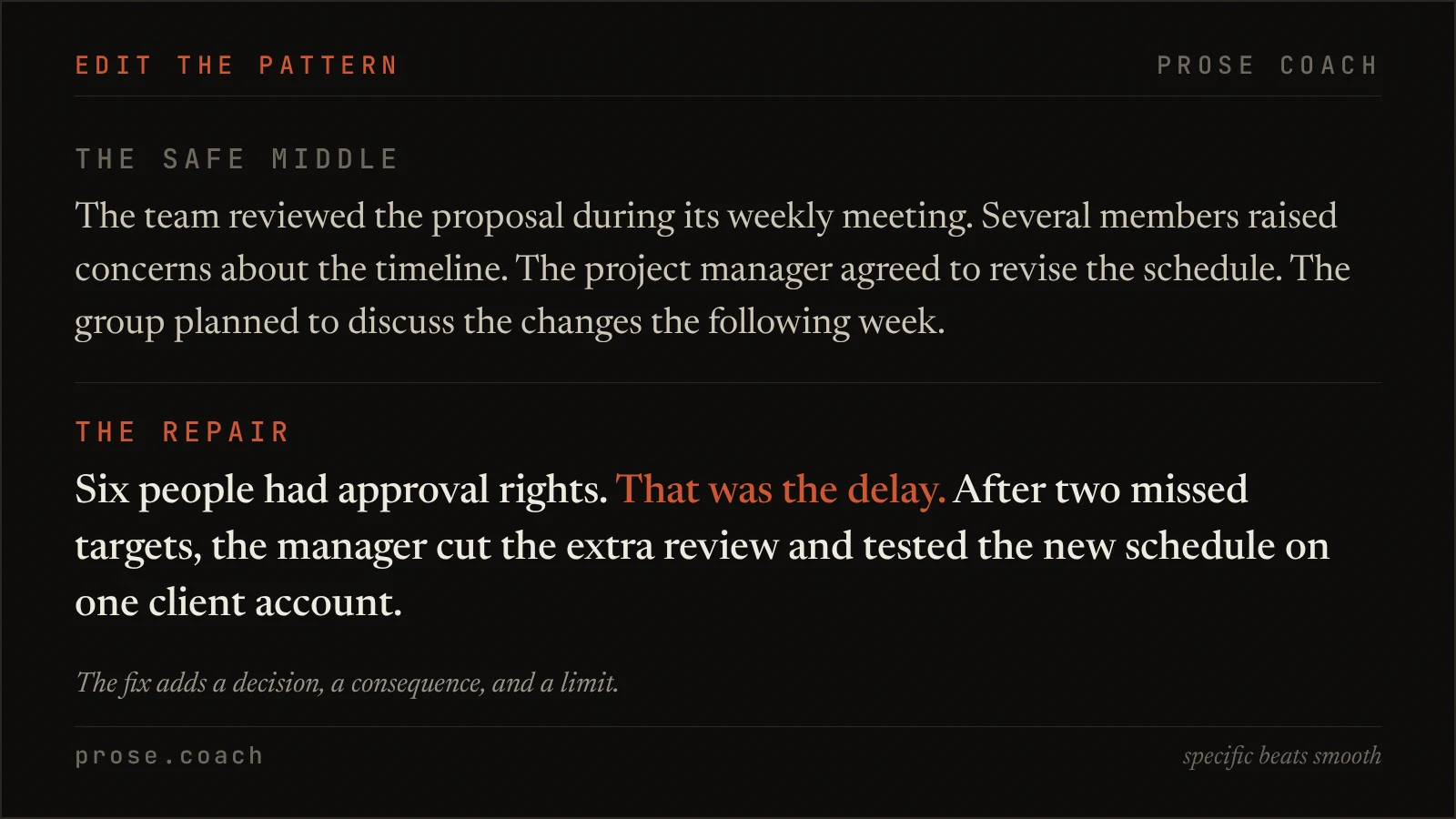
The team reviewed the proposal during its weekly meeting. Several members raised concerns about the timeline. The project manager agreed to revise the schedule. The group planned to discuss the changes the following week.
Nothing is grammatically broken. Every sentence simply performs the same job in the same shape. The paragraph moves in a neat row, and the reader can predict the next step before it arrives.
A stronger revision gives each sentence a different responsibility:
Six people had approval rights. That was the delay. After two missed targets, the manager cut the extra review and tested the new schedule on one client account.
The revision doesn't add random mess. It adds a decision, a consequence, and a limit. The prose changes because the thinking changed.
A score can't establish authorship
A detector sees the finished text, not the writing process. It doesn't see the outline in your notes, the abandoned opening in your document history, or the twenty minutes you spent replacing one vague sentence with a specific one.
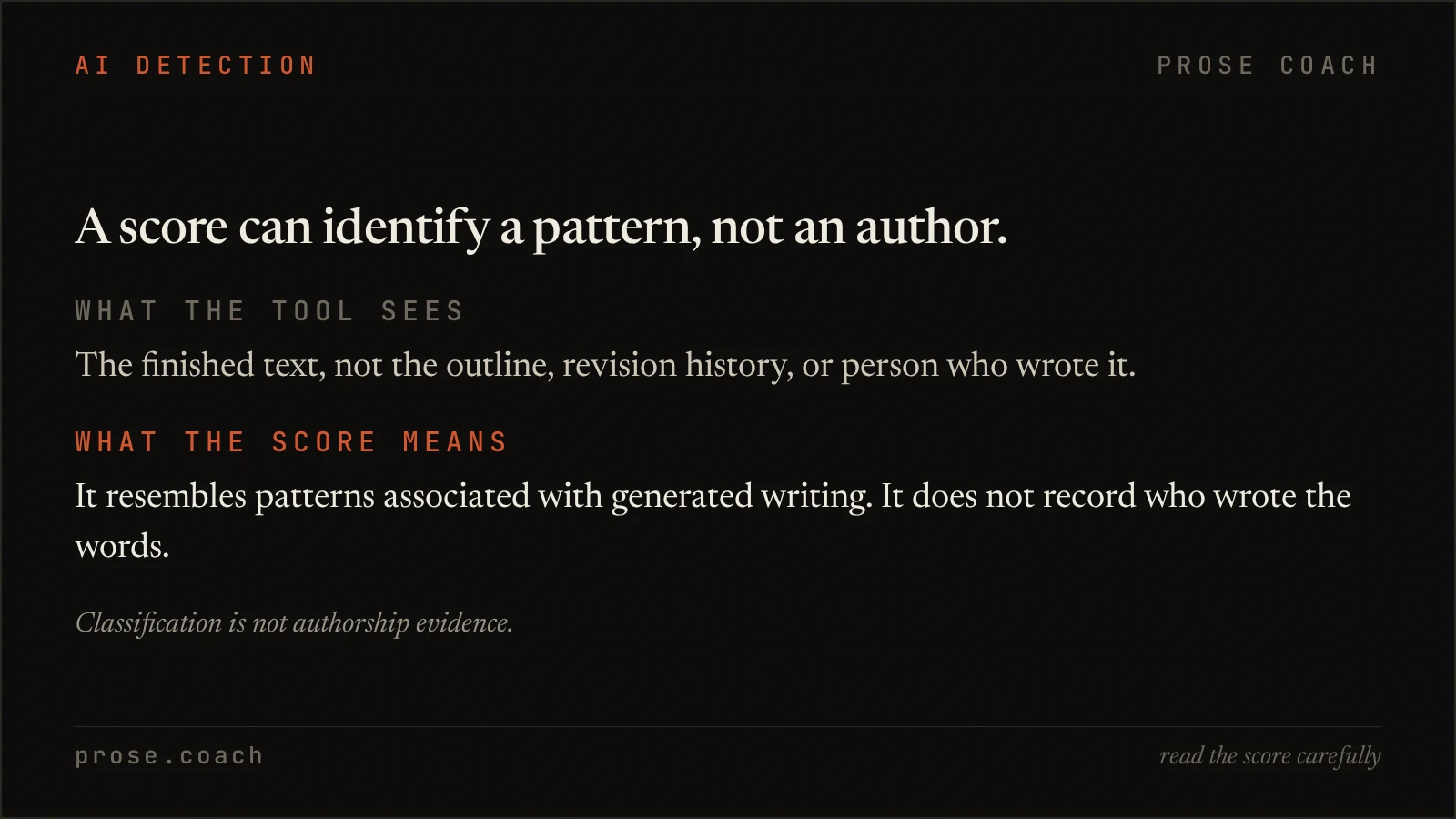
That missing context creates a hard ceiling on accuracy. A high score may mean the passage resembles the patterns the tool associates with model output. It may also reflect formal training, heavy editing, a narrow subject, or a short sample with too little variation. A low score doesn't prove that a model wasn't involved either.
If a school or employer treats the score as conclusive, the process has outrun the evidence. Why AI detectors flag writing you actually wrote covers the practical response when a false positive becomes an accusation: preserve revision history and ask how the number was produced.
The responsible use is narrower. Use the result to locate a passage worth reading closely. Don't use it to replace judgment.
Compare tools by failure mode
A useful accuracy comparison asks where each tool breaks.
Some systems are better at long passages than short ones. Some struggle when a human edits model output. Some produce different results after a light paraphrase. A tool that catches obvious, untouched model prose may be less useful for the mixed drafts people actually send.
You should also separate a plagiarism checker from an AI detector. One searches for matching source language. The other estimates whether the writing's patterns resemble generated text. A clean plagiarism result says nothing about the second question.
The cost of chasing a score is easy to miss. You can spend an hour swapping synonyms, make the draft less precise, and still leave the repeated paragraph structure untouched. How to rewrite AI text to sound human shows the better order: decide what the sentence means, then repair the shape carrying that meaning.
Edit what the score points toward
Start with the passage that triggered concern, not the entire document. Mark repeated sentence openings, soft claims, generic nouns, and paragraphs that explain the point twice.
Then ask three questions.
Does the paragraph name a person, decision, or consequence that matters? Does the sentence length follow the idea, or does every line arrive on schedule? Does the ending add information, or does it simply announce that the paragraph was useful?
Keep the clean sentence when it earns its shape. A short line can be human. A passive sentence can be right. Variation isn't a costume you put on after the detector complains.
Prose Coach scans vocabulary, sentence habits, and document structure together, so the edit reaches the pattern instead of chasing a score. PRO places the writing rules inside ChatGPT, Claude, Cursor, or Gemini before the draft settles into the safe middle.
The best outcome isn't a low number. It's a document with visible choices, specific evidence, and a voice that remains recognizable when the model leaves the room.
FAQ
Are AI detection tools accurate?
They can identify patterns associated with generated writing, but accuracy depends on the sample, the tool, and the kind of text being tested. A score cannot prove authorship.
Can an AI detector give a false positive?
Yes. Formal human writing, short passages, heavily edited drafts, and writing shaped by rigid instruction can resemble the patterns a detector flags. A score needs context and process evidence.
What do AI detectors look for?
They look for statistical regularity in word choice, sentence rhythm, and document structure. Different tools weigh those signals differently.
Does a low AI score prove a person wrote the text?
No. A low score only means the passage did not resemble the tool's target patterns strongly enough. It doesn't record who wrote the words.
How should I respond to an AI detector score?
Use it as a prompt for close editing, not as a verdict. Review the flagged passage, preserve your revision history, and ask what method produced the result before making a claim about authorship.