By Prose Coach · July 25, 2026
Human Writing Patterns AI Models Can't Replicate
AI can imitate the surface of your writing. It can copy your sentence length, favorite phrases, and level of formality. What it struggles to reproduce is the reason you made one choice instead of another.
TL;DR: Human writing feels human when it contains specific judgment, uneven emphasis, and details chosen for a reason. AI models can imitate those features one paragraph at a time, but they tend to flatten them across a full draft. Protect your decisions, not your quirks.
Human writing is a record of choices
Most advice about humanizing AI text focuses on visible features: contractions, varied sentence lengths, casual phrases. Those edits help, but they don't create a voice. A model can add “I think” to every other paragraph and still sound like a brochure.
The stronger signal is choice. Why did you include this example? Why did you stop the paragraph here? Why did you use the same technical word twice instead of reaching for a synonym?
Those decisions give prose a point of view. Brand voice works through decisions, not adjectives, and the same rule applies to AI-assisted writing that isn't brand copy.
Three patterns models imitate badly
1. Uneven emphasis
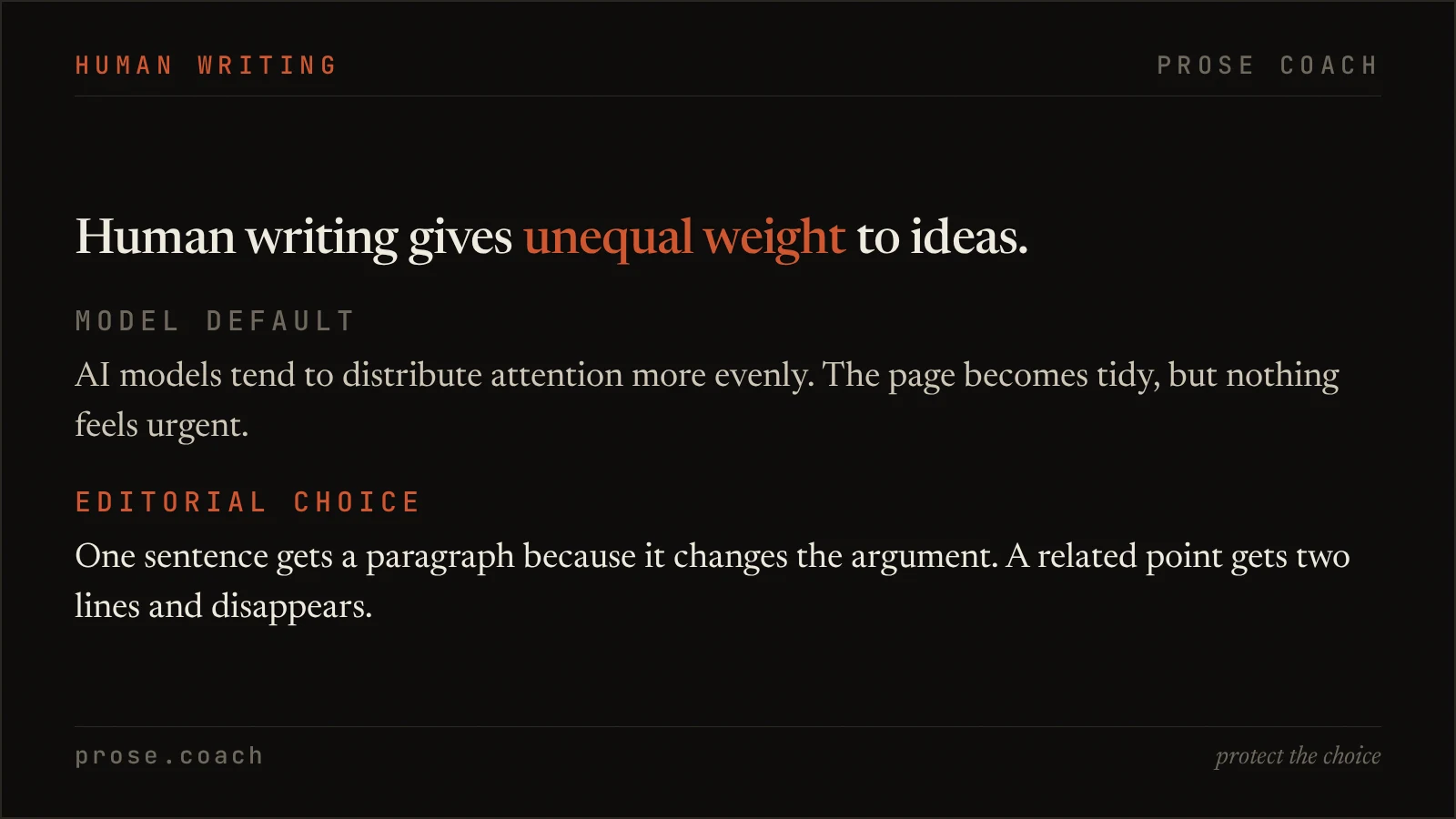
Human writers don't give every idea equal space. One sentence gets a paragraph because it changes the argument. A related point gets two lines and disappears.
AI models tend to distribute attention more evenly. They explain the main idea, add a supporting example, then give the example its own mini-conclusion. The page becomes tidy, but nothing feels urgent.
Look at the difference:
The new approval process improved communication across the team. It also helped everyone understand their responsibilities and work more efficiently.
The second sentence receives nearly as much weight as the first while adding almost no information. A human editor might cut it, then spend the saved space on the actual consequence:
The new approval process stopped three people from editing the same headline in different documents.
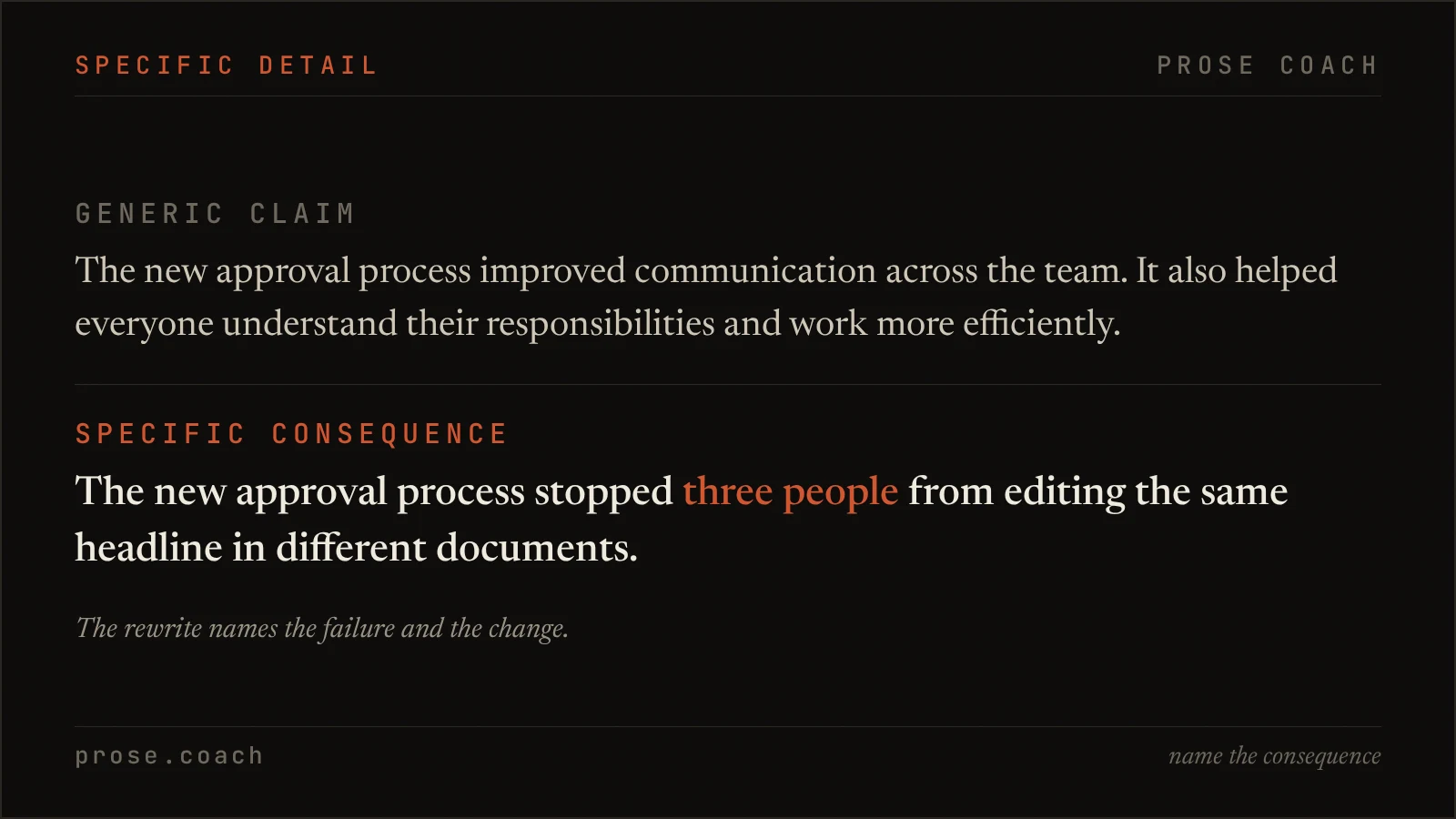
That sentence earns its space. It names the failure and the change. It doesn't explain why clarity and efficiency are good.
2. Details with a job
AI can add detail on command. Ask for a more vivid paragraph and it may supply a quiet office, a blinking cursor, or a late-night deadline. The detail sounds plausible, but plausibility isn't the same as relevance.
Human writers choose details because those details prove something. A product manager mentions the approval file that never reached design because the failure explains the new handoff. A founder mentions the customer who canceled because that loss changed the pricing decision.
The test is blunt: remove the detail. If the argument stays exactly the same, the detail was decoration.
This is also where false personalization causes trouble. Invented anecdotes can make a draft feel more lived-in while making it less trustworthy. Use a real detail, or make the claim without one.
3. A sentence that refuses the expected ending
Models like to complete the pattern. A paragraph introduces an issue, explains its effect, and closes with a lesson. The ending is grammatical and predictable.
Human writers sometimes stop after the evidence. Sometimes they add a qualification that weakens the clean conclusion. Sometimes they turn the argument in a direction the reader didn't expect because the facts require it.
Consider this ending:
Better prompts can improve the draft, but they won't supply the judgment the writer avoided making.
It doesn't wrap the section in a motivational bow. It names the limit. That limit matters because every writing tool has a trade-off: speed gained through generation creates review work later, especially when the model softens claims or adds unsupported certainty.
Don't manufacture randomness
Once writers learn that uniform prose can sound generated, they often overcorrect. They add fragments, unusual words, and abrupt sentence breaks until the draft feels erratic.
Random variation is still a pattern. Readers notice when every paragraph contains one fragment, one rhetorical question, and one sentence that begins with “But.” The writing has traded machine regularity for human costume.
The better approach is to make rhythm follow the thought. A short sentence can land a decision. A longer sentence can carry the qualification that keeps the decision honest. Then the next paragraph can move at a different speed because it has a different job.
Sentence rhythm is one of the tells a word-level edit misses. Vocabulary variety won't solve a page whose paragraphs all breathe the same way either, as this analysis of word choice and AI detection explains.
Protect the draft's pressure points
The most human parts of a draft usually appear where the writer has something to lose: a claim that could be challenged, a concession that complicates the pitch, or a detail that reveals how the decision happened.
Mark those pressure points before asking an AI tool to revise. Tell the model what cannot become softer, what evidence must remain intact, and which phrase carries the writer's actual judgment. Then inspect the revision for three kinds of drift:
- The claim got safer.
- The example got more generic.
- The paragraph gained a closing sentence that repeats the point.
That scan catches more than a synonym pass because it checks the choices that make the draft yours.
Automate the check, keep the voice
You don't have to scan for these patterns manually. Prose Coach places pattern rules inside ChatGPT, Claude, Cursor, or Gemini, then checks the draft that remains for repeated structure, flat cadence, cushion language, and voice drift.
That removes some review work without pretending the tool can make the judgment for you. Prose Coach can't decide what only you would say. It can keep the model from sanding that decision down into generic prose.
FAQ
What makes writing sound human?
Specific judgment makes writing sound human. The writer chooses which detail matters, how much space an idea deserves, and where the argument needs a qualification instead of a neat ending.
Can AI copy a human writing style?
AI can copy visible features of a style, such as vocabulary, sentence length, and tone. It has a harder time preserving the underlying decisions across a long draft, especially when the topic or audience changes.
How do I humanize AI text without making it random?
Edit for reasoning and structure before adding surface variation. Cut generic examples, sharpen weak claims, and let sentence rhythm follow the job each paragraph needs to perform.
Should I add personal details to AI writing?
Add details only when they're true and they support the claim. Invented anecdotes create false texture, not a real voice.
Does an AI writing filter guarantee a human score?
No. A filter can reduce patterns that make prose feel generated, but no tool can guarantee a detector result or establish authorship from text alone. The writer still has to review the facts and the argument.