By Prose Coach · July 27, 2026
Wordtune Alternatives: Pick the Tool That Fixes the Right Problem
Most Wordtune alternatives promise a better rewrite. That comparison is too shallow. The useful question is what kind of writing problem you need the tool to fix.
TL;DR: Choose a Wordtune alternative by the level of editing you need. Grammarly handles correctness, Hemingway exposes dense sentences, QuillBot paraphrases, and ProWritingAid analyzes longer work. If the problem is flat rhythm, repeated structure, or lost voice in AI-assisted drafts, use a pattern-based editor instead of another sentence rewriter.

Wordtune works at the sentence level
Wordtune is built for the moment when a sentence feels wrong but you don't want to rebuild the page around it. It can shorten a line, change its tone, or offer another phrasing. That makes it useful for email edits and quick revisions.
The limit is scope. A sentence rewriter sees the line in front of it. It may improve six sentences separately while leaving all six with the same job, pressure, and polished finish.
Consider this paragraph:
Our team reviewed the campaign strategy and identified several opportunities for improvement. We developed a revised plan to improve communication and increase engagement. The new approach will help the organization achieve stronger results.
A sentence tool can swap words inside each line. The real problem sits above the wording: three abstract claims, no named decision, and a final sentence that repeats the promise.
A structural edit changes the thought:
Donors stopped opening the campaign emails after the third generic update. We cut the internal recap, led with the funding gap, and gave each message one job.
That revision isn't a paraphrase. It replaces categories with evidence and gives each sentence a different responsibility. The full AI content editing workflow explains why argument and structure should come before vocabulary.
The best alternatives solve different jobs
There isn't one best Wordtune alternative because these tools don't all compete at the same layer.
Grammarly is the practical choice when correctness and clarity are the main concern. It catches mechanical errors across the places people already write. Its suggestions can also smooth tone, though heavy acceptance may push distinct phrasing toward a shared professional middle.
Hemingway Editor is narrower and useful because of it. It exposes dense sentences, passive constructions, and readability problems. It won't decide whether your argument deserves the space, but it can show where a reader has to work too hard.
QuillBot focuses on paraphrasing. That helps when you need another way to phrase a sentence or compress a passage. It can also create a false sense of progress: new vocabulary doesn't repair a repeated paragraph shape. Vocabulary variety won't beat a structural pattern.
ProWritingAid suits writers who want reports across longer work. Its analysis can surface pacing, repetition, and style habits that disappear during line-by-line editing. The trade-off is review time. More reports create more decisions, and some flags describe a deliberate choice instead of a flaw.
Writers working on fiction have another concern: continuity across a long draft. A long-form AI writing tool may help with planning and production, but generated chapters still need human judgment about emphasis, character voice, and what the prose should leave unsaid.
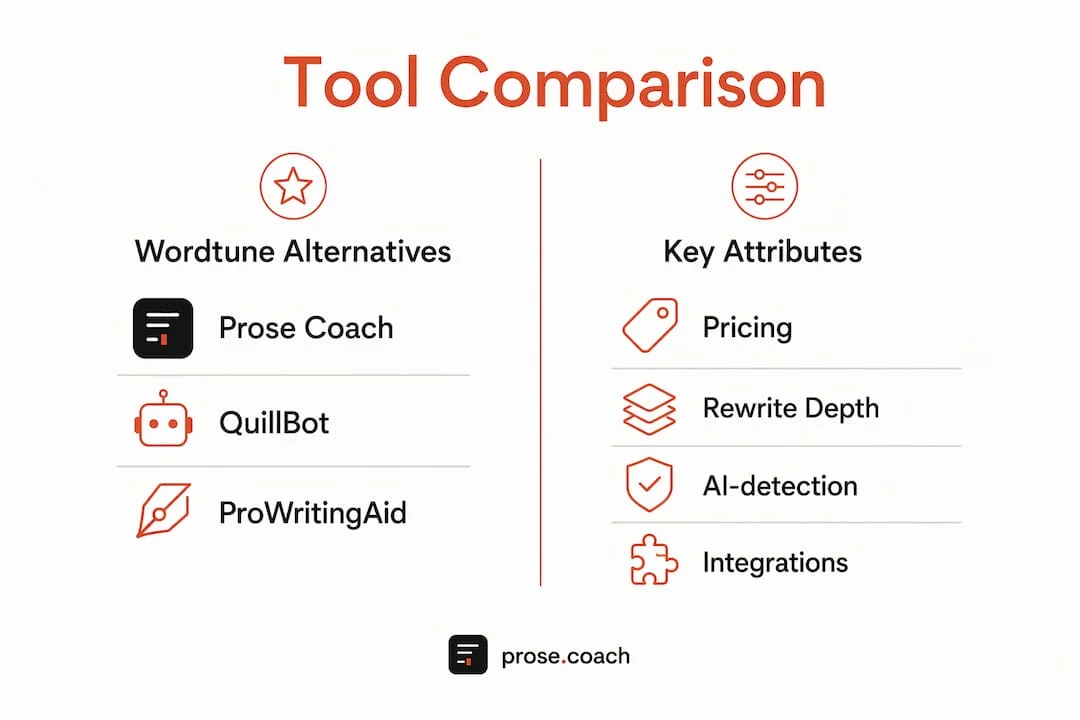
Compare tools by editing depth
A better comparison uses three layers.
Line editing fixes grammar, clarity, and awkward phrasing. Grammarly, Hemingway, and Wordtune work well here because the unit of attention is a sentence.
Passage editing checks rhythm, repetition, paragraph jobs, and transitions. ProWritingAid can expose some of these patterns through reports. A human editor can see them directly by reading the draft as a sequence instead of a collection of lines.
Draft-system editing changes the rules before or during generation. This matters when you use ChatGPT or Claude often enough that the same safe habits keep returning. Fixing each instance after the fact becomes expensive.
Prose Coach sits at that third layer. It loads editing rules into the model and uses a deterministic scanner to mark the patterns that remain, so it addresses repeated structure and voice drift without promising a detector score.
Don't choose by feature count
Feature tables reward whichever product has accumulated the most toggles. They say little about whether the tool fixes your bottleneck.
Run one representative passage through a trial or free version. Then compare the original and revision with three questions:
- Check whether the claim changed or the tool only swapped wording. If the position stayed vague, the rewrite didn't reach the real problem.
- Read neighboring sentences for repeated jobs.
- Compare the revised paragraph with the source writer's natural voice.
The answer may point to two tools instead of one. A grammar checker can clean mechanics before a pattern-based pass. That pairing costs more time than clicking a single rewrite button, but it keeps each tool inside the job it handles well.
Don't chase random irregularity. Adding fragments and odd synonyms can make a draft less readable without making it more personal. Sentence rhythm should follow meaning, not a formula for alternating short and long lines.
The trade-off no comparison table fixes
Structural editing asks more from the writer. A line rewriter can return an answer in seconds. Structural revision may reveal that the paragraph has no evidence, the example is generic, or the conclusion isn't supported.
That cost is real. It is also why structural work lasts longer than a synonym swap. You aren't trying to fool a score. You're deciding what the draft means, where it takes a position, and which details prove the point.
FAQ
What is the best free alternative to Wordtune?
The answer depends on the job. Grammarly is useful for basic correctness, Hemingway for readability, and QuillBot for limited paraphrasing. Prose Coach offers a free pattern scanner for structural and vocabulary habits in AI-assisted drafts.
Is Grammarly better than Wordtune?
Grammarly is a better fit for grammar, clarity, and broad writing support. Wordtune is more focused on producing alternate sentence phrasing. Neither tool replaces a structural edit when the whole passage repeats the same shape.
What should I use instead of Wordtune for AI-assisted writing?
Use a pattern-based editor when your drafts have flat rhythm, generic examples, repeated section shapes, or voice drift. A sentence rewriter can improve individual lines while preserving those larger habits.
Can a Wordtune alternative guarantee that AI detectors won't flag my writing?
No. Detector models change, and a score can't prove authorship. Choose tools that improve clarity, specificity, and structure, then keep revision history when authorship matters.