By Prose Coach · July 24, 2026
An AI Content Editing Workflow That Doesn't Flatten Your Voice
Most AI drafts don't need a synonym swap. They need an editor who can tell which choices came from the writer and which came from the model's default settings.
TL;DR: A useful AI content editing workflow moves from argument to structure to sentence rhythm, then checks the draft against your voice. Start by cutting weak claims and repeated paragraph shapes. Polish vocabulary last, because polished generic writing still sounds generic.
Editing after generation is already late
The familiar workflow is simple: ask for a draft, fix grammar, change a few words, publish. It preserves the parts readers notice first: the cautious claim, identical paragraph shapes, and tidy conclusions that say nothing new.
AI writing can sound acceptable sentence by sentence. The problem appears across the page. Sections open with definitions, examples stay broad, and paragraphs land at the same temperature.
That is why structural tells matter more than isolated words. A draft can avoid obvious filler and still carry the same machine-shaped rhythm.
The workflow has three passes, not one cleanup lap
An effective AI content editing workflow separates decisions that editors usually blur together.
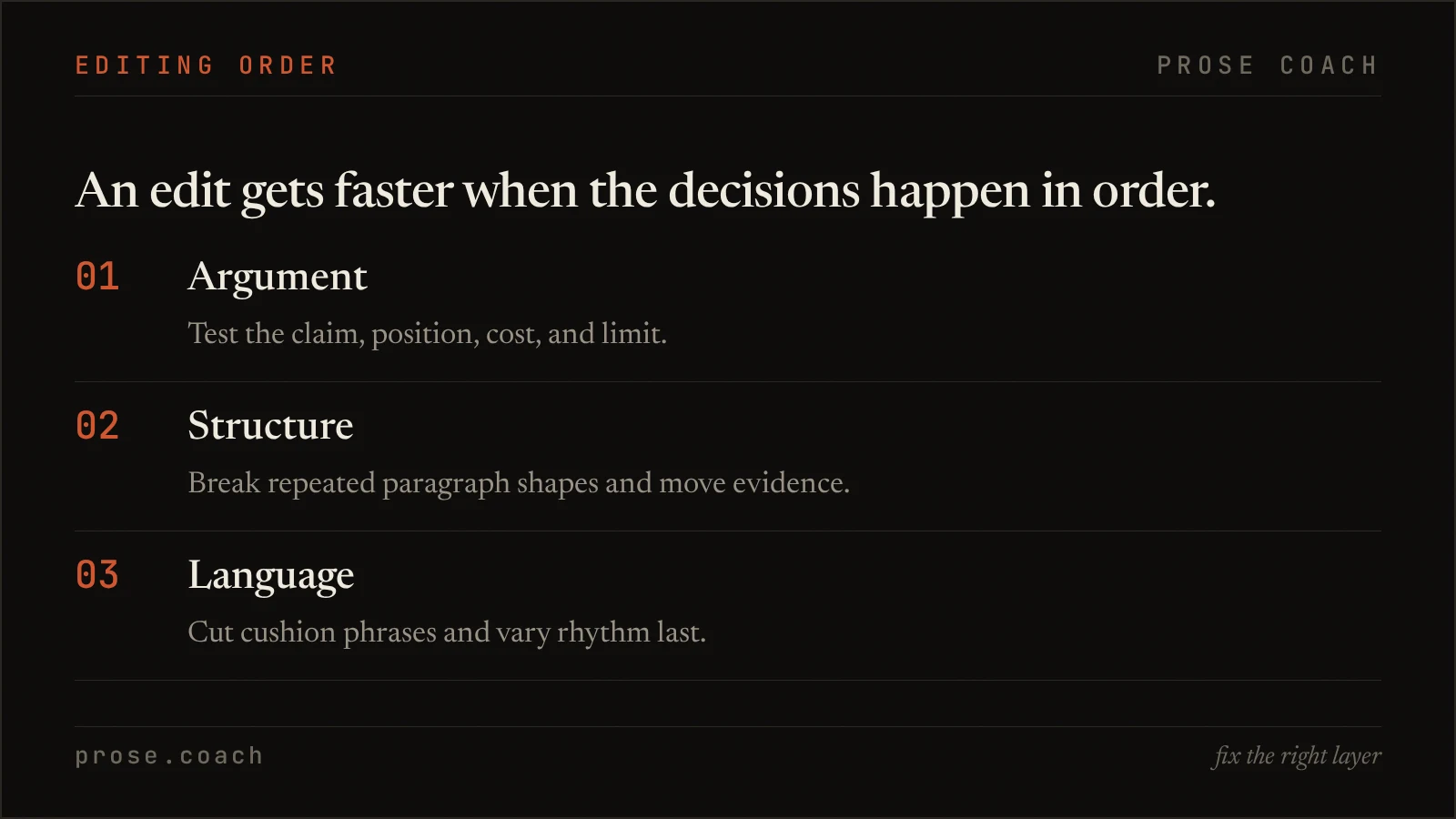
First, test the argument. What is the sentence claiming? Where does it take a position? What cost or limit would make it more believable?
Next, test the shape. Does each paragraph have a different job, or does every block state, explain, illustrate, and summarize on schedule? Break the sequence and move evidence closer to the claim it proves.
Last, test the language. Cut cushion phrases, replace container words with evidence, and vary rhythm where the thought changes pressure. Vocabulary is the final pass.
This order saves time. It prevents you from polishing a paragraph you should have rebuilt.
Pass one: make the draft choose
Weak AI prose protects itself with words like “may,” “could,” “various,” and “important.” Those words aren't always wrong. They become a problem when they let the sentence avoid a decision.
Here is the kind of line that needs surgery:
It could be argued that a thoughtful content strategy may help organizations communicate more effectively with their audiences.
The sentence is grammatical and useless. It offers no audience, mechanism, or risk.
Try this instead:
A content strategy fails when it gives every reader the same explanation. Your sales page, onboarding email, and renewal note need different jobs.
The rewrite creates a test. A reader can disagree with it, which means the writer finally said something.
Don't force every sentence into a hot take. A qualified claim can be accurate. Make the qualification specific instead of removing every hedge.
Pass two: break the paragraph machine
Models favor reusable structures because reusable structures rarely fail grammatically. A section introduces the topic, expands it, offers three examples, then closes with a lesson. Repeat until the article ends.
Readers feel the pattern before they name it. Predictable prose feels impersonal even when the information is correct.
Give neighboring paragraphs different jobs. Let one make the claim. Let the next show the failure. Let a third explain where the advice stops working. A short paragraph can carry the consequence. A longer one can hold the qualification.
Cut sentences that merely translate the sentence before them:
The new approval process reduced delays. This helped the team work more efficiently and improved overall productivity.
The second line adds no result. Replace it with the thing that changed:
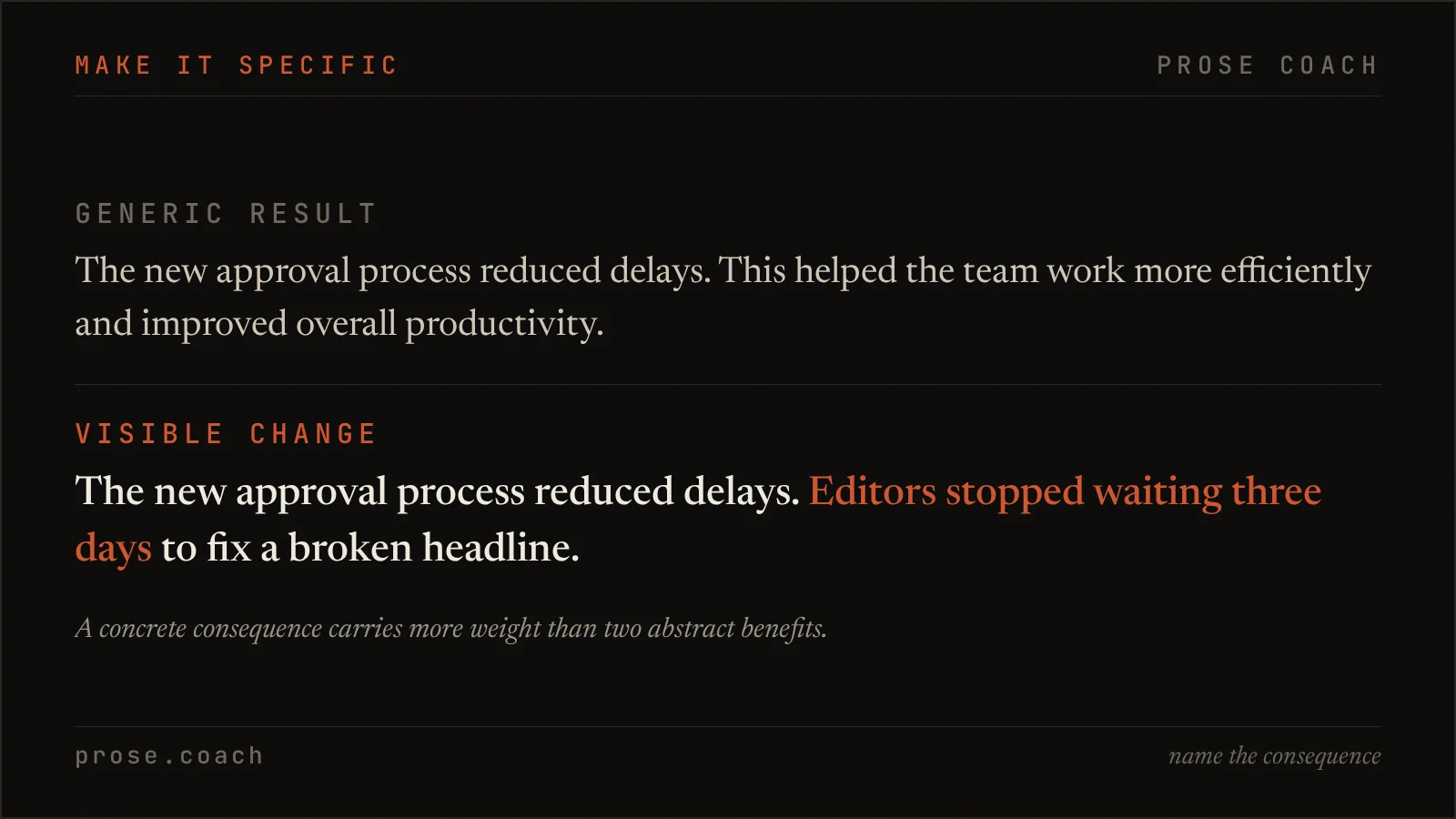
The new approval process reduced delays. Editors stopped waiting three days to fix a broken headline.
Length isn't the point. The sentence names a consequence a reader can picture.
Pass three: make rhythm follow meaning
Sentence variety isn't a metronome. Short, long, short, long is another template if you apply it everywhere.
Let the thought set the pace. Use a blunt sentence when the claim needs force. Let a longer sentence carry the qualification when the easy version would mislead. Keep a fragment when it sounds like something you would actually say.
Read the draft aloud. Mark where your voice speeds up, stops, or changes direction. If every sentence arrives with the same cadence, change one sentence's structure rather than sprinkling in random short lines.
The goal isn't mess. The shape of the prose should match the pressure of the idea. Sentence rhythm is one of the tells a word-level edit misses.
The cost of a real edit
A serious edit takes longer than running a humanizer or replacing “important” with “meaningful.” It may expose a weak idea you hoped polish would hide.
That trade-off is the point. Fast surface edits preserve the draft's bad decisions. A slower pass can remove a whole paragraph, change the order of the argument, or admit that the evidence doesn't support the claim.
Don't invent personal details to make AI prose feel lived-in. A fake anecdote is still fake. Use a real example or leave the detail out.
Put the filter where the writing happens
The cleanest workflow catches defaults before they spread through a finished draft. Prose Coach places its pattern rules inside ChatGPT, Claude, Cursor, or Gemini, then gives you a deterministic scanner for the draft that remains. It works on structure, cadence, vocabulary, and voice instead of pretending a few synonym swaps made the writing personal.
The human still makes the important calls: what to claim, what to cut, and what only this writer would say.
FAQ
What is the best AI content editing workflow?
Move through the draft in order: argument, structure, rhythm, then vocabulary. This keeps you from polishing sentences that need a new claim or a different paragraph job.
How do I edit ChatGPT output without losing my voice?
Keep the decisions, phrases, technical terms, and examples that belong to you. Remove the model's repeated structures and generic cushion language, then read the revision aloud to catch places where the cadence no longer sounds natural.
Should I use an AI humanizer or edit the draft myself?
Use an editing workflow that changes reasoning and structure, not a tool that swaps words. Surface-level humanizers can leave the same predictable shape while making prose less precise.
Can an AI writing filter replace a human editor?
No. A filter can identify patterns and enforce rules, but it can't decide whether a claim is true or worth making. That belongs to the writer.
Does better editing guarantee that AI detectors won't flag my writing?
No detector result proves authorship, and no editing system can guarantee a score. Better editing makes prose clearer and less mechanical, which is better than chasing a number. The goal isn't mess. It's correspondence between the shape of the prose and the pressure of the idea. Sentence rhythm is one of the tells a word-level edit misses.