By Prose Coach · July 26, 2026
Bypassing Copyleaks: What the Workarounds Miss
Search volume for bypassing Copyleaks says something specific about the market: a lot of people are being scanned, and almost none of them know what the scan measures.
That gap is where the humanizer industry makes its money. It sells a workaround for a scoring system most buyers have never had explained to them.
TL;DR: Copyleaks measures statistical properties of text, not authorship. Tools sold to defeat it work until the model updates, and a confirmed evasion attempt costs more than a flag does. The durable move is a pipeline where the writing is genuinely revised and the process is documented.
What Copyleaks is measuring
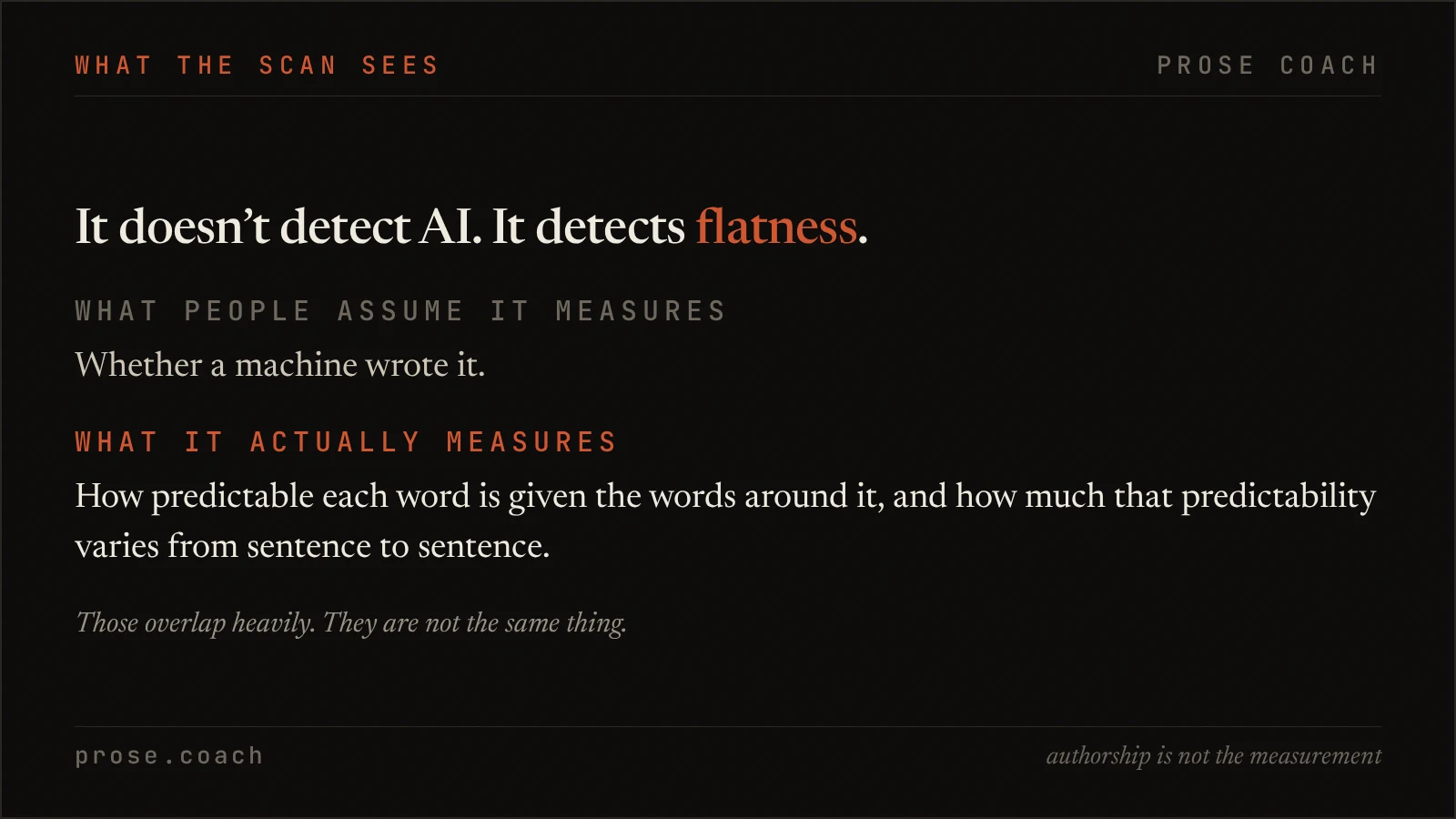
Copyleaks runs two separate scans that get discussed as if they were one. The plagiarism scan compares your text against indexed sources. The AI scan looks at statistical properties of the writing itself: how predictable each word is given the words around it, and how much that predictability varies from sentence to sentence.
The second scan is the one people try to beat, and it's worth being precise about what it can and can't tell you. It doesn't detect AI. It detects flatness. Those overlap heavily, which is why the tool is useful, and they aren't the same thing, which is why it produces false positives.
Both scans are sold to institutions rather than individuals, and they're embedded in systems like Canvas and Blackboard where a flag opens a human review rather than closing a case. That context is the part most bypass content leaves out.
Why the workarounds don't hold
The pitch is straightforward: paste your text, get it back rearranged, submit with a clean score. The problems are also straightforward.
Detectors retrain. A humanizer that clears a threshold in March is running against a different model by autumn, and nobody sends you a notice when the score you paid for stops holding. Any claim of permanent evasion is a claim about a competitor's future release schedule.
The output degrades. Most of these services work by substitution and reordering at the sentence level, which introduces the awkward phrasing that a human reviewer catches even when the scanner doesn't. You can pass a scan and fail the editor.
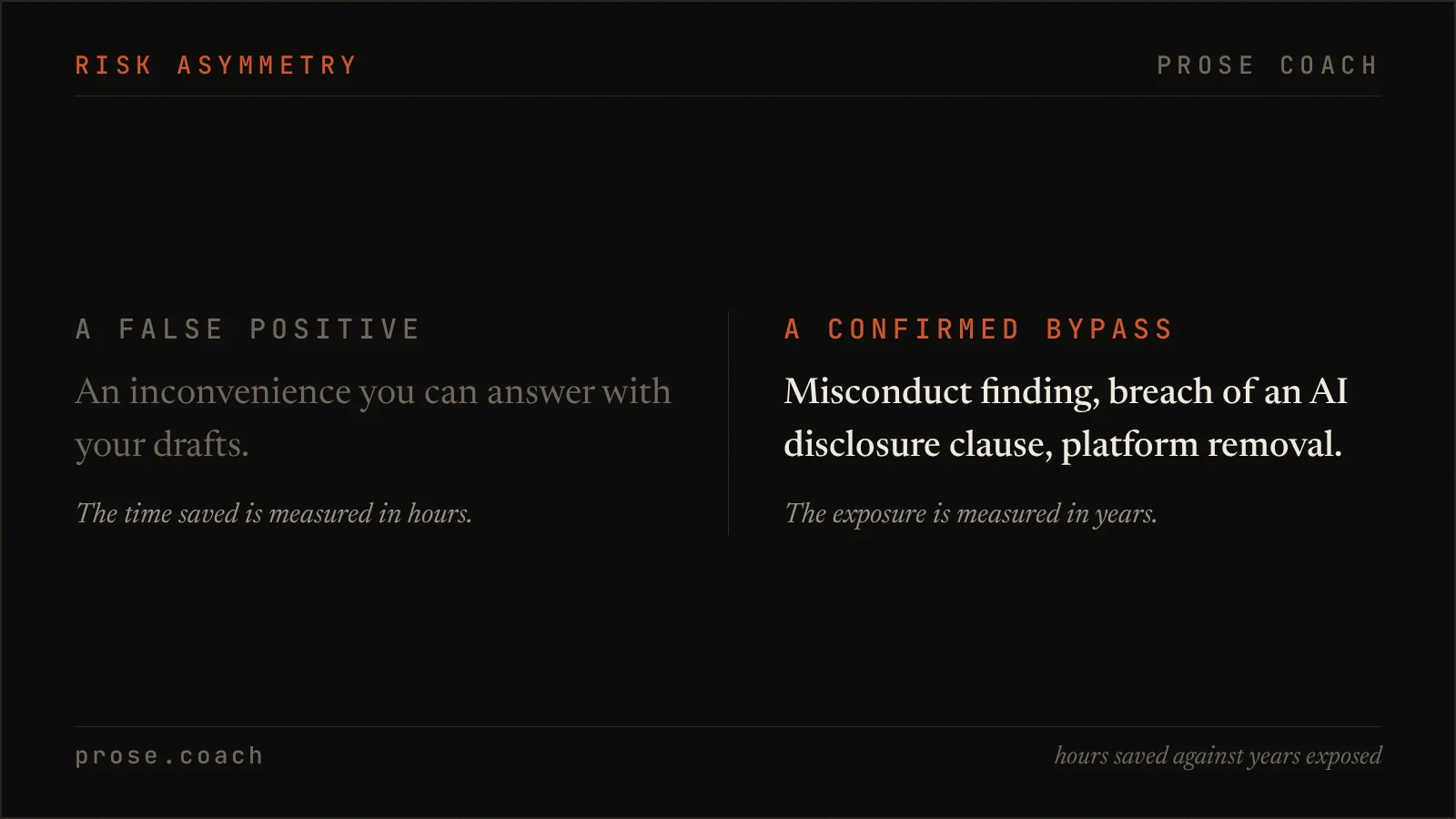
And the downside is asymmetric. A false-positive flag on honest work is an inconvenience you can answer with your drafts. A confirmed attempt to defeat the scan is a different category of problem: academic misconduct findings, breach of an AI disclosure clause in a client contract, platform removal. The time saved is measured in hours. The exposure is measured in years.
What a flag actually costs you
Ask what happens next, because the answer changes the strategy.
At most institutions and most publishers, a flag routes to a person. That person wants to see the work behind the work: draft history, source notes, the version from three days before the deadline. Writers who can produce that evidence resolve flags. Writers who can only produce a finished file and an explanation do not, regardless of whether they were honest.
This is why documentation beats evasion as a defensive strategy. It answers the actual question being asked.
Short passages under roughly 150 words produce unreliable scores across every detector. Non-native English writers draw false positives at higher rates because their sentence patterns read as statistically regular. Clean, well-structured formal prose does the same. If you've been flagged on work you wrote, that failure mode has a mechanism, and it isn't your integrity.
Building a pipeline that survives review
For teams publishing at any volume, this stops being a personal question and becomes a process question. The pipeline that holds up has gates in it.
- Draft in whatever model you prefer. Treat the output as raw material.
- Mark the weak parts before editing anything. Generic examples, thin arguments, paragraphs that could describe any company. Reading for weakness first keeps you from polishing something that shouldn't survive.
- Add the part only you have. Your data, your customer's objection, the thing that went wrong last quarter. This is the step that changes the statistics, because specific content is less predictable content.
- Run a structural pass. Sentence length, paragraph shape, opening lines, transitions.
- Add a quality gate before the originality scan, not after. Originality scanning tells you whether text matches a source. It says nothing about whether the copy is accurate or on-voice. Teams running product catalogs handle this with a review layer, using something like MerchUp to catch voice and accuracy drift in product descriptions before anything reaches a scanner. Quality scoring alongside originality scanning is the combination that catches both failure types.
- Keep the trail. Timestamps, prompt history, tracked changes. Cheap to keep, impossible to reconstruct later.
The cost of this is real: it's slower than submitting a raw draft. What you get back is work that holds up in review and copy that's better on the merits, which are usually the same edits.
Prose Coach is not a bypass tool
Worth stating plainly, since this page will be found by people looking for one.
Prose Coach is a revision skill that installs inside ChatGPT, Claude, or Cursor. It scans a draft for the structural and rhythmic patterns that make writing read as machine-made, names the sentence causing each one, and shows the rewrite. It doesn't scramble text, it doesn't promise a score, and it can't tell you what any detector will say about your work.
What it does is make the underlying problem visible, which is the only version of this that keeps working after the next model update. The free tier covers the core pass. PRO is a one-time $39 purchase.
If you want the whole sequence in order, the editing workflow lays it out step by step.
Can you actually bypass Copyleaks?
Not reliably, and not permanently. Detectors retrain on a schedule nobody outside the company knows, so any tool clearing a threshold today is making an unenforceable promise about tomorrow.
What causes Copyleaks false positives?
Short passages, non-native English phrasing, and clean formal prose all read as statistically regular, which is the property the AI scan measures. Human-edited AI text also lands in the ambiguous middle.
Is Prose Coach a Copyleaks bypass?
No. It's a revision system that identifies flat structure and repetitive patterns in a draft. It makes writing better and more specific, which tends to help, but it offers no detector guarantee and doesn't claim one.
What should I do if I'm flagged on work I wrote?
Assemble the evidence before you respond: draft timestamps, version history, prompt records if you used a model, and source notes. Present a one-page timeline with the files attached rather than a long explanation.
Does citing sources reduce a Copyleaks flag?
It reduces similarity scores on the plagiarism scan and gives a reviewer something concrete to check. It has no direct effect on the AI scan, which measures writing structure rather than sourcing.