By Prose Coach · July 23, 2026
Brand Voice AI Doesn't Need More Adjectives
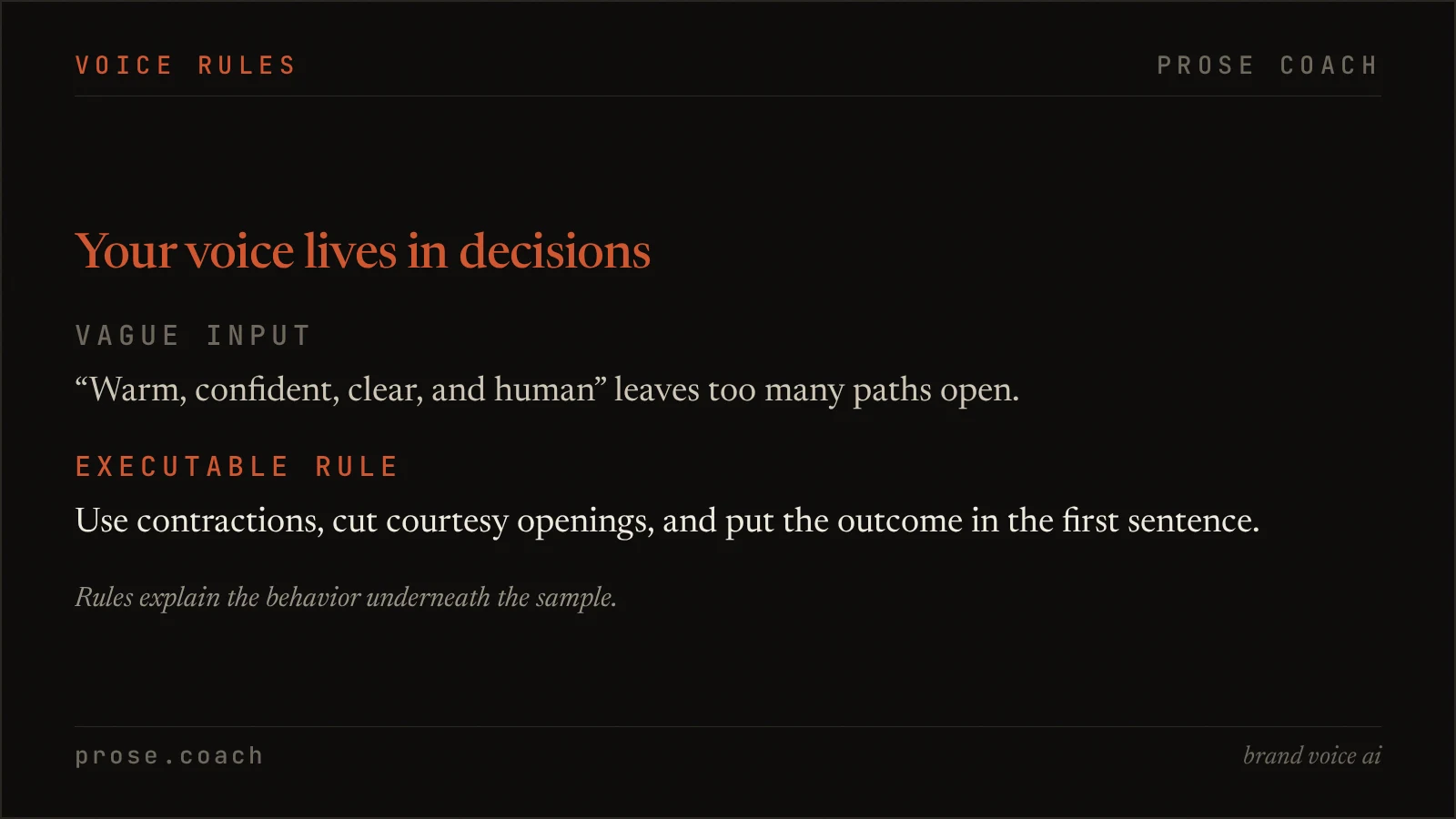
Most brand voice guides are adjective piles. “Warm, confident, clear, and human” sounds useful until an AI has to choose between a blunt sentence and a polite one. Then it falls back to the safest version, and every channel starts sounding like the same company.
TL;DR: Brand voice AI works when you give the model behavioral rules and real examples, not a list of tone words. Keep voice stable, let tone change by context, and review the decisions that make the writing recognizable.
Your voice lives in decisions
Voice isn't a mood board. It's the pattern of choices a reader can recognize.
Do you state the problem before the context? Do you name the person responsible, or hide behind “the team”? Do you keep a technical term because precision matters, or replace it with a smoother synonym? Those choices tell a reader more about a brand than “bold” ever will.
AI needs those choices stated plainly. “Sound conversational” leaves too many paths open. “Use contractions, cut courtesy openings, and put the outcome in the first sentence” gives the model something it can execute.
This is the same reason writing voice drifts across an AI draft. A sample can show the surface. Rules explain the behavior underneath it.
Samples need annotations, not admiration
Five good samples are a start. Five good samples with notes are much better.
Take a sentence from an email and explain why it works. Maybe it names the missed deadline without making the reader defensive. Maybe it uses a short sentence after a dense one because the decision needs room. Maybe it repeats “client owner” three times because changing the label would create confusion.
The annotation turns taste into instruction. Without it, the model copies visible features and invents the rest.
Consider this sample:
We missed Friday's launch because the approval file never reached design. I'm changing the handoff so one owner signs off before production starts.
The useful rules aren't “be confident” or “sound human.” They are more specific: keep the actor visible, name the failure, and end with the next control. Those rules can travel to a memo, a product update, or a customer email.
Voice stays put. Tone moves.
Your brand shouldn't sound identical in a crisis email and a LinkedIn post. That doesn't mean the voice changed.
Voice is the underlying set of decisions. Tone is the adjustment made for the reader and the situation. A support reply may be patient and plain. A launch announcement may be brisk. Both can still name actors, cut filler, and lead with the point.
The mistake is creating a separate personality for every channel. That produces five disconnected brands and a review process nobody can maintain. Build one core voice profile, then add a small channel layer: formality, length, allowed humor, and the action the reader should take.
If your draft already sounds generic, don't begin with more channel instructions. Start with the structural patterns AI detectors flag, because a different platform wrapper won't fix a repeated paragraph shape.
The polished draft can still be wrong
Brand consistency has a cost when people confuse it with sameness.
If every paragraph has the same length, every transition announces itself, and every conclusion restates the opening, the copy may look controlled while saying very little. A reader can feel the template before noticing the vocabulary.
Here is the kind of output that passes a style check and fails a human one:
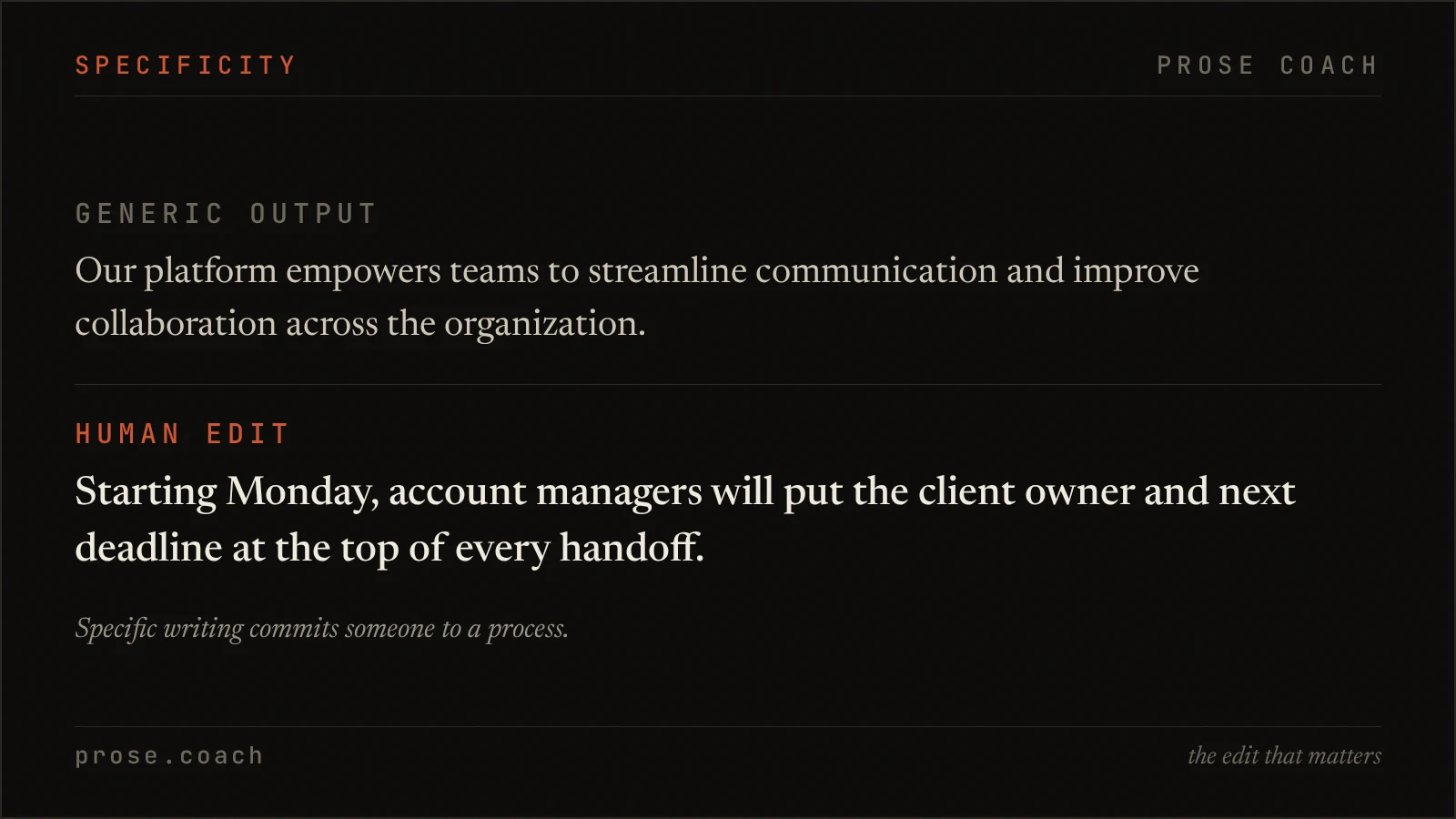
Our platform empowers teams to streamline communication and improve collaboration across the organization.
It has the right temperature. It has no information. Which team? What broke? What changed?
Try this instead:
Starting Monday, account managers will put the client owner and next deadline at the top of every handoff. Sales can stop digging through six-message Slack threads to find the reply.
The second version is more specific, but it also carries a trade-off. It commits the team to a visible process. Someone can now disagree with the rule, which is exactly what makes the sentence useful.
That is why vocabulary variety won't beat AI detection. Rare synonyms can decorate a generic claim. They can't supply the decision the claim avoided.
Put the rules where the draft is made
Most teams keep the voice guide in a document and paste it into a prompt when they remember. That makes consistency depend on memory, which is a poor operating system for a content team.
The better place for the rules is inside the writing workflow. Keep the core profile close to the model, include a few annotated examples, and add a short check for the habits that flatten the output: soft openings, actorless sentences, repeated transitions, and closing lines that explain the sentence before them.
Prose Coach applies that kind of structural filter inside ChatGPT, Claude, and Cursor. It helps shape the draft before the generic rhythm settles in, while leaving the actual ideas and brand judgment with the writer.
Review for recognition, not obedience
An AI voice profile is working when a colleague can identify the brand without finding identical phrases everywhere. The test isn't whether every sentence obeys a checklist. It's whether the draft keeps making the same meaningful choices under different pressure.
Read one human-written piece beside one AI-assisted piece. Mark the places where the writer takes responsibility, changes pace, uses a precise term, or stops without a ceremonial conclusion. If those decisions disappear in the AI version, the profile needs rules, not more adjectives.
How do I create a brand voice for AI?
Collect representative writing samples, then annotate the decisions that make them work. Turn those observations into executable rules about openings, sentence rhythm, actors, vocabulary, and paragraph shape.
What's the difference between brand voice and tone in AI writing?
Voice is the stable pattern of choices that makes the writing recognizable. Tone changes with the audience and situation, such as a formal support reply versus a brisk product announcement.
Can AI keep a brand voice across different channels?
Yes, if the workflow separates core voice rules from channel-specific tone rules. A single profile should govern the decisions that stay stable, while each channel adds only the constraints its reader needs.
Why does AI-generated brand copy sound generic?
Models often choose safe language when the prompt gives them only broad adjectives. The draft becomes generic because it avoids actors, concrete consequences, and meaningful variation in structure.
Does Prose Coach guarantee that AI writing will pass a detector?
No. Prose Coach filters structural and vocabulary patterns that can make writing feel machine-generated, but no tool can guarantee a detector result or prove authorship from text alone.