By Prose Coach · July 20, 2026
How to Keep Your Writing Voice Consistent With AI
AI can imitate your tone for a paragraph. Keeping your voice across a full draft is where the imitation breaks.
The opening sounds like you. Five paragraphs later, the prose has drifted into office sludge. Sentences run longer, while claims get softer.
It’s writing in the statistical average of every professional document it has seen.
Readers forgive an awkward word. They notice when the person speaking seems to change halfway through the page.
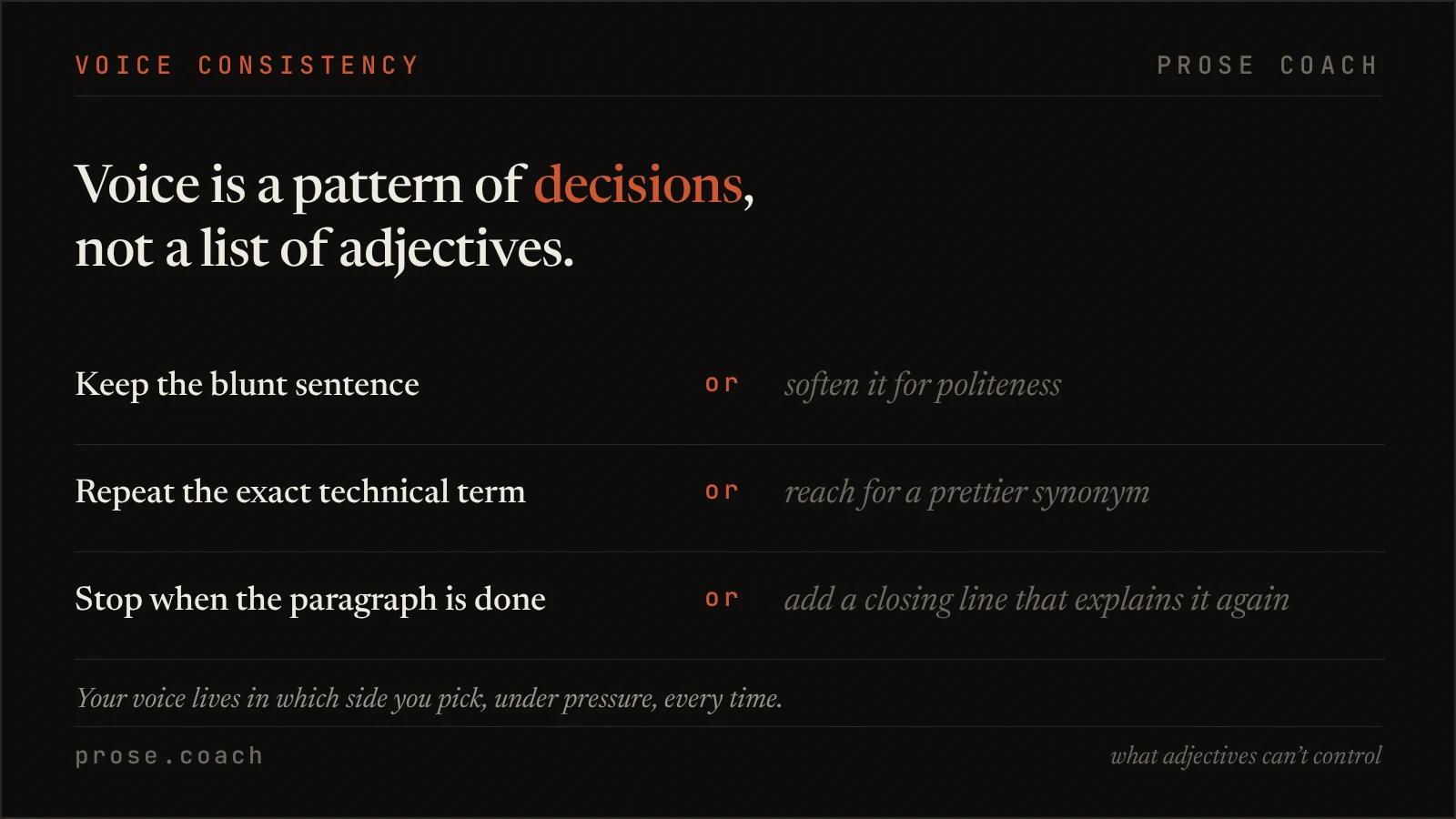
Voice is a pattern of decisions
Most prompts treat voice as a list of adjectives. Writers ask for copy that feels “direct, warm, and confident,” then wonder why the result could belong to anyone.
Those labels don’t tell the model what to do when two good choices conflict. Should it keep the blunt sentence or soften it for politeness? Should it repeat the exact technical term or reach for a prettier synonym?
When a paragraph feels complete, should it stop or add a closing line that explains the point again?
Your voice lives in those decisions.
One writer cuts the courtesy sentence and opens with the problem. Another keeps the greeting because the relationship matters. One uses fragments when the point needs pressure.
Rules control the behavior.
The model drifts toward the safest version
Give an AI a strong sample and it can mimic obvious features such as short paragraphs and contractions. The trouble starts when the draft moves beyond situations shown in the sample.
At that point, the model has to infer what your voice would do. It often chooses the safest option because safe language fits more contexts.
The sentences become evenly sized. Qualifications creep in, and every section gets a small conclusion.
Consider this update:
We missed Friday’s launch because the approval file never reached design. I’m changing the handoff so one owner signs off before production starts.
The sentence names who failed and what changes next. Ask a model to extend it without firm constraints, and the next paragraph may slide into this:
Moving forward, this revised process will help improve communication and ensure that all team members have greater clarity around their responsibilities.
The second passage avoids blame and information. “Help improve” weakens the claim. “Greater clarity” names no action.
The voice didn’t drift because the model forgot a preferred adjective. It drifted because nothing told the model to keep actors visible and consequences concrete.
Consistency can become a costume
There’s a bad fix for voice drift: force every sentence through the same style mold.
A prompt may demand short sentences and blunt claims. By page two, the reader can predict every stop.
What began as voice has become a tic.
Too much consistency carries a real cost. It makes prose rigid, even when the chosen style looks informal.
A person doesn’t use one cadence for a client complaint and a reflective essay. The underlying judgment stays recognizable, but the register changes with the room.
Voice consistency preserves the writer’s habits of thought while the delivery responds to context. It doesn’t freeze every paragraph at the same temperature.
If the model keeps resetting each section into the same shape, structural tells AI detectors flag shows where to look.
Examples beat labels, but rules keep them useful
Writing samples give a model evidence. A blunt email shows how you handle pressure and how much proof you expect before making a claim.
But samples leave gaps. The model may copy a quirk without understanding its job.
It sees fragments and adds them for decoration. One aside becomes a license to drop jokes into material that needs restraint.
Rules explain the choices behind the samples. “Use a fragment only when it carries new information” keeps the cadence from turning theatrical.
“Don’t close by restating the section” stops the model from adding a polished bow. Keeping the same technical term when a synonym would blur the meaning preserves clarity.
Prose Coach puts those constraints into the model’s working instructions, then checks the draft for drift in cadence and structure. The aim isn’t to stamp one voice onto every format. It’s to keep the model from replacing yours with its default.
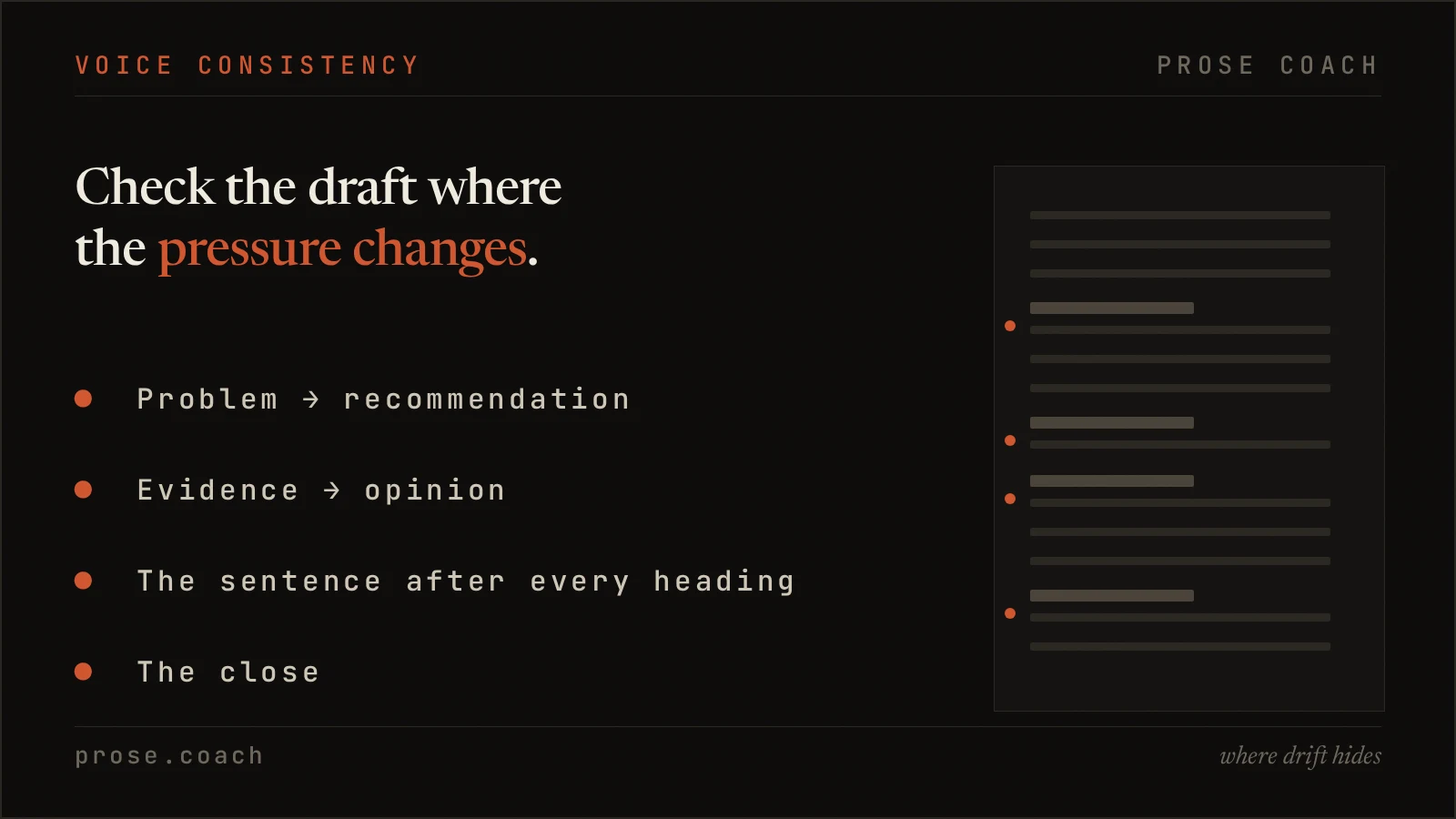
Check the draft where the pressure changes
Voice drift rarely announces itself in the first lines. Check the turn from problem to recommendation, then the point where evidence becomes opinion. Pay closest attention when the model tries to close.
Read the first paragraph beside the last. Do they make claims with the same level of nerve? Does the ending suddenly sound more formal, more cheerful, or less specific?
Inspect the sentence after every heading. Models treat a new section as permission to reset, so a sharp opening can lead into generic topic sentences.
One final test catches the worst drift. Read a paragraph without the nouns tied to its subject. If the sentence could appear in a project update or sales email unchanged, the model has stopped making your decisions.
Cut that paragraph back to the fact only you would choose. Then let the voice follow it.